



Digitalization is bridging the trade gap during COVID-19 pandemic









The beginning of 2020 will certainly be remembered as a period of the global fight against the coronavirus. Although its impact on a global population may not seem like something extraordinary when we compare it with other known diseases, yet all governments around the world have started taking action to ensure that this number does not increase significantly.
Nevertheless, the impact of undertaken measures has already proved that it has an unprecedented effect on the previously known model of life and the global economy. The Organization for Economic Co-operation and Development (OECD) has become the first international institution that has indicated that the current pandemic and related economic effects could lower global GDP growth by half this year, compared to the previous forecasts.
The direct result of the fight with the COVID-19 is and will be, an unprecedented decline in international economic exchange. Broken supply chains, closed borders, suspended transport, falling demand abroad - these are the major problems faced by companies which activity is based on international trade. The pandemic has meant that both importers and exporters have shifted their focus primarily on "here and now."
When I have asked President of the Polish-Asian Chamber of Commerce, Janusz Piechociński, about his commentary on the current global situation, he has admitted that "the world has changed, and much of it (unfortunately) for worse."
The deputy prime minister and minister of economy of Poland from 2012 to 2015 observes that "in response to the [COVID-19] threat, some countries are showing a clear temptation to isolate themselves and to return to self-sufficiency." Piechociński explains that "globalization and international relations are currently being perceived more as a threat than an opportunity, and undisguised protectionism or even economic nationalism and egoism are on the rise." What he further asks is this: "Is it possible in the era of global threats (even those of health or climate nature) to build a world that is afraid of itself and is closing itself even more?"
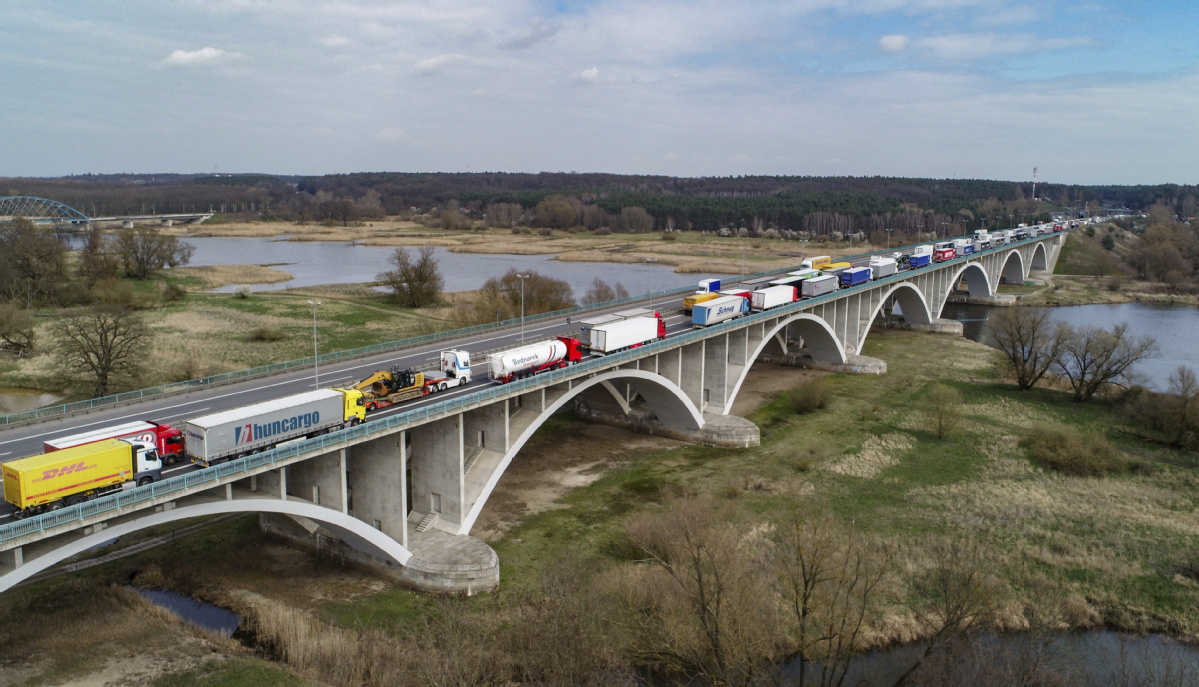
Long traffic jam at the border to Poland. The coronavirus has disrupted the global supply chain on a massive scale. /AP
The Chinese character for "crisis" carries a second meaning: Opportunity. And this opportunity (in our case) can be an ability to taking advantage of the intensification of existing trends, such as accelerated digitalization and further development of increasingly advanced forms of distance trading.
"Because of the pandemic threat, we do not fly to meetings and expos today, but more intensively, we transfer contacts and dialogue to the Internet… Now it's time for webinars, teleconferences, online expos and exhibitions to be treated as the basic, and not complementary, mechanism of distance cooperation," said Piechociński.
It looks that Poland is a perfect example of this new trade thinking since first-ever China (Poland) International Digital Trade Expo is currently taking place. The event started on 29 April 2020 and is finishing on 15 May 2020. Its aim is to present the new and innovative service model of "Internet, Exhibition, Trade," where "through the cooperation of productivity, China and countries along the 'One Belt One Road' achieve the aim of common development" during the testing time of the pandemic.
However, it is worth noting that the Expo is not the only initiative of this kind. The SinoCham, in cooperation with China Chamber of Commerce for Import and Export of Machinery and Electronic Products (CCCME) and local authorities of the Zhejiang province in China, invites companies from Poland to participate in the online B2B meeting "China (Zhejiang)-Poland" taking place on 11-15 May 2020.
What the example of Poland is proving, and was summarized by Janusz Piechociński, is that "we need to think together how to heal the wounds of late deliveries, discontinued production or lost profits from transactions that did not occur… not with court judgments and mutual accusations, but with solidarity and concern for current and future relations."
Since we are on the threshold of a new economic, social and political era, it depends on all of us whether we will welcome it with fear or open to the amazing opportunities that it is presenting to us. It is up to us whether we learn from the past or will we learn to sense the future.





