



AI can make difference in fighting virus









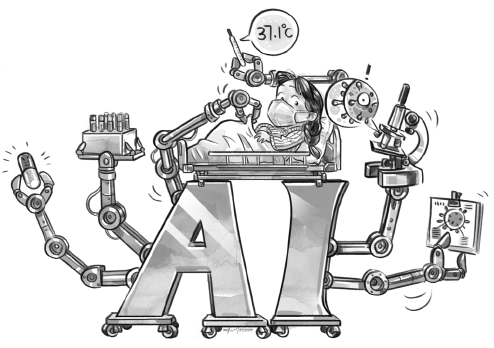
High technologies, represented by artificial intelligence and robots, will widely and deeply change people's lives and work. At the moment, China, in the middle of a grim fight against the novel coronavirus, could well make use of these technologies to help contain the epidemic and treat those infected.
First, AI, along with big data, could support the prevention and control of the virus. The misreporting of the daily infection data, which is probably inevitable with manual statistics, could be reduced by AI. For instance, we could quickly ascertain the movements made by those infected by plotting their cellphone positioning. While knowledge about the infected people's close contacts and the possible transmission scope and route could be gained by using the big data from tourism and transportation. Furthermore, facial recognition could be used to reduce or prevent unnecessary flows of people. Although people's privacy must be protected in the process.
Second, AI could help make projections of the epidemic situation. By monitoring and analyzing virus transmission and the effectiveness of treatments, it could thus guide the ongoing prevention, control and treatment work based on transmission, treatment and quarantine. In this way limited medical resources could be used most effectively.
Third, AI could be employed to help monitor, control and guide public opinion. Internet technologies could be used to reassure the public and recognize and stop rumors, as well as advocate effective prevention and protection measures. Using AI and big data, false information and rumors can be identified effectively before they spread online. Besides, medical chat robots could provide information about the outbreak and give suggestions, saving medical resources.
The use of robots could largely reduce infections through contact. It is essential to reduce the contacts between people. Limiting outside activities and implementing home quarantine and observation are required. In rural areas, unmanned aerial vehicles could be used to monitor quarantines.
But people still need to replenish daily necessities, and there are a lot of application scenarios for robots not only in treatment and services for the people infected with the virus but also logistics services for the healthy.
For example, hospitals could use robots to deliver meals and medicines to medical staff and patients, which would not only save manual labor but also reduce the chance of infection. In terms of education, online classes should be promoted in the fight against the coronavirus outbreak. For jobs that don't need close contacts, telecommuting is a preferred solution.
AI could also help coordinate the distribution of medical supplies and reduce the man-made unreasonable distribution, which has provoked the loudest public outcries in the outbreak. If the scarce materials are allocated unfairly and the medical staff are not protected effectively, the battle against the outbreak will be significantly hindered. AI technology could be employed to analyze the demand for materials of each department and implement smart distribution according to the medical supply stock, thus facilitating the smooth containing of the virus.
Finally, AI can help expedite the research and development of antiviral medicines. It could be used in simulations of various treatment methods and techniques and figure out the characteristics of the virus. A number of reports in recent years on smart medicine R&D indicate that AI will be more widely applied in areas including genetics and pharmaceutical manufacturing.
Therefore, AI should play a strong supportive role in the fight against public health threats and guide public opinion in the event of an emergency, even though the difficulty in data accumulation and acquisition may somewhat restrict the role that AI can play.
AI and robotics will certainly exert more influence in the future and Chinese people's experience in fighting the novel coronavirus will have enduring effects in a number of areas such as healthcare, transportation and education.
Zhang Junsheng is a research fellow at the Institute of Scientific and Technical Information of China. Sun Yunchuan is a professor at and director of International Institute of Big Data in Finance of Business School of Beijing Normal University. The views don't necessarily represent those of China Daily.


Today's Top News
- China's action against unjustified extraterritorial sanctions is necessary and proportionate
- China blocks US sanctions on five Chinese firms over alleged Iran oil ties
- China assumes rotating presidency of the UN security council
- UN presses for talks amid recession fears
- Social safety net law to protect vulnerable
- US' proposed curbs on Chinese entities opposed





