



ICU team makes real impact on front line









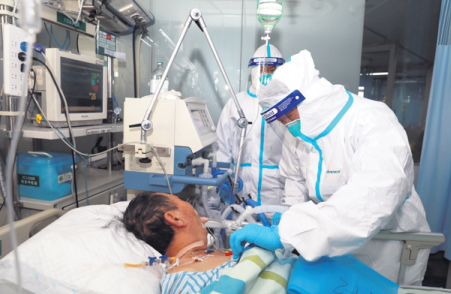
The first coronavirus patient in Hubei province to be treated with extracorporeal membrane oxygenation therapy-which provides prolonged support for the heart and lungs-was discharged from Wuhan University's Zhongnan Hospital on Jan 28.
It was the 22nd day that Peng Zhiyong, head of the department of critical care medicine at the hospital, and his team had worked on the front line combating the virus in Wuhan, the city where the outbreak started.
In addition to the patient who was cured, the team has applied ECMO therapy to three other infected people: one has been removed from the intensive care unit and one is still receiving ECMO support.
The third patient died, despite being placed on one of the ECMO machines, which temporarily take over the work of the heart and lungs, allowing them to rest and heal. The treatment is used during life-threatening conditions, such as severe lung damage from infection, and the process takes place outside the body, Peng said.
"ECMO is a lifesaving therapy that is used in the ICU when we have no other alternative," the 53-year-old said, noting that it is only used when the usual treatments to ease oxygen deficit, such as inhaling oxygen with the help of breathing masks or tubes, have failed and the patient will die within a day.
Each ECMO machine costs 70,000 to 80,000 yuan ($10,000 to $11,400), resulting in the treatment costing nearly 200,000 yuan per patient.
"That's why some of the infected patients who were given ECMO were later taken off the therapy,"Peng said.
He and his team work more than 12 hours a day in the ICU-"the most poisonous ward", as he called it-and have managed to keep the mortality rate to less than 20 percent.
The strict preventative measures taken meant that only one of the 150-strong team became infected with the virus, and even then the infected person only displayed minor symptoms.
When he arrives at the hospital at 7:30 every morning, Peng takes his own temperature. "Whoever has a fever must take a break that day. Before we enter the quarantine area, it takes 10 minutes to don our protective gear," he said, adding that the process involves wearing three layers of clothing.
Peng and his team members have trained how to remove protective gowns that are contaminated with the virus. "The virus is over almost the entire surface of our gowns, so it is easy for medical workers to get infected by touching contaminated areas, especially when they take off the dirty clothes," he said.
He and his colleagues eat lunch sitting back to back to avoid close contact and possible transmission.
Owing to a shortage of medical supplies in Wuhan, Peng only gets two sets of protective gowns during his period of duty, which lasts from 8 am to 6 pm every day.
"The lunch break is our only chance to drink, eat and go to the restroom in the whole day," he said.
This is not the first time Peng has been on the front line in the battle against infectious disease, having treated patients during both the 2003 outbreak of severe acute respiratory syndrome and the 2016 avian flu epidemic.
"Although the lethality of the novel coronavirus has so far been much lower than SARS, we still can't underestimate it because the incubation period is longer and the symptoms are less obvious," he said.
He acknowledged that he feels under greater pressure than before. That's because he participated in the first two missions as an individual doctor, but this time he is the leader of an ICU team.
"I have to protect both the patients and medical workers in my team," he said, adding that he and his wife, also a medical professional in Wuhan, support each other's work.
"We seldom have time to communicate, and we don't take smartphones with us during work, but we have a mutual understanding," he said.
When a reporter from online portal The Paper asked what he will do when the epidemic is finally defeated, he replied,"I will give my family a big hug."


Today's Top News
- Xi urges all-out rescue work after fireworks plant explosion causes heavy casualties
- Standoff deepens in Hormuz
- Gig economy, digital platforms teaming up to reshape work
- TV makers putting on big show abroad
- 'One-person companies' taking economy by storm
- Privately backed nuclear plant a crucial milestone





