



Austrian engineer builds deep links with China









Herbert Mang could have, like many of his peers, retired more than 10 years ago. But the 78-year-old is still relishing the satisfaction that comes with his research and teaching university students.
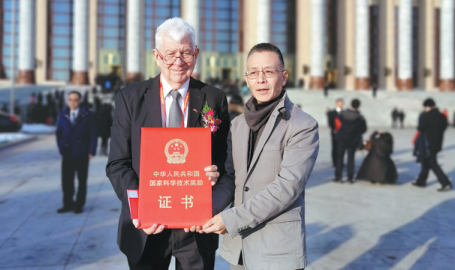
On Jan 10, the Austrian civil engineer was rewarded for his seemingly endless drive when he was presented with the International Science and Technology Cooperation Award, the highest accolade a foreign scientist can receive in China.
Mang is the first Austrian scientist to receive the honor.
Considered one of the world's leading experts in the field of computational mechanics, Mang is no stranger to awards. He has received accolades such as the City of Vienna Award for Natural Sciences and the Kardinal Innitzer Prize for Natural Sciences.
But this latest award, he said, is the most significant.
"Civil engineering is not always regarded as a very sophisticated field. Some people say it's down-to-earth compared with the more glamorous fields such as physics and chemistry. I'm very happy for my profession that the Chinese appreciate this field," said Mang during his most recent visit to Tongji University in Shanghai.
Computational mechanics refers to the development of mathematical models that can quantify the response of a structure to external forces, or loadings, such as wind, snow, earthquakes and fires. According to Mang, the field is essential to the safe and economical construction of buildings.
"Before the advent of computational mechanics, buildings did not last long. Yes, there are famous structures that have stood for centuries, but in the grand scale of things, these buildings make up only a tiny fraction of everything that has been built," Mang said.
"Today, with computational mechanics, engineers build structures with the aim of seeing them last for more than a century. This was never the case in the past."
The professor's working relationship with Chinese scientists is longstanding and stretches back to 1981 when he arrived in China as a delegate of the United Nations Industrial Development Organization.
Mang spent three months at the Zhengzhou Research Institute For Mechanical Engineering in Henan province, where he conducted courses on computational mechanics. He also helped the institute with its application to the World Bank to purchase mainframe computers.
Changing times
Following his stint in Zhengzhou, Mang went on to lend his expertise to major engineering projects in cities such as Beijing and Xi'an, Shanxi province.
"China had a completely different culture and political system and I was simply curious to learn more about the country. Also, very few people went to China at that time, and I was eager to take on this challenge," he explained.
Mang recalled that Zhengzhou was hardly impressive when he arrived. There were no cars on the roads, just bicycles. The landscape was devoid of tall structures and the computer facilities at the institute were outdated. He was impressed, however, by the local scientists at the institute. In fact, Mang got along so well with them that he eventually invited three of them to Vienna to work with him.
The change that China has undergone, he added, has been dramatic. "China was technologically backward then. Today, China is ahead in the world when it comes to using and developing electronic devices. Just see how all the young people are constantly on their phones," he said.
In 2004, Mang started collaborating with Tongji University on a regular basis. Since receiving a professorship at the university in 2012, Mang has visited the campus up to three times every year. His contributions include helping pave the way for the establishment of the China-Austria Tunnel and Underground Engineering Research Center, a joint venture by Tongji University and the Austrian Eurasian Pacific Academic Association. The center has played an integral role in fostering greater exchange between scientists and students from China and Austria.
Mang's expertise has also been critical in the construction of some of China's most notable engineering feats-the Shanghai Tower and the Hong Kong-Zhuhai-Macao Bridge. He worked alongside his Chinese counterparts to evaluate the influence of high dynamic loads and extreme temperatures on the undersea tunnels that are part of the bridge.
Although he will soon turn 80, Mang has no intention to quit what he loves doing. In fact, he is planning to submit a research proposal related to China's Belt and Road Initiative to the Austrian Science Fund.
"The new Silk Road will go through mountainous territories and the structures involved will be in danger of landslides, avalanches and earthquakes. This is where my expertise can come in. Also, I'm fascinated with China's goal of connecting with Europe," he explained.
"Besides, all this cooperating with China, attending conferences and working with students on research projects makes me feel young."


Today's Top News
- Xi's inspiring messages to youth
- In China's healthcare gap, an AI doctor steps in
- Trump says US to begin guiding ships out of Strait of Hormuz
- Authority of Tokyo Trials 'must not be challenged'
- Beijing bans US sanctions on five Chinese cos
- Africa eyes benefits from tariff waiver





