



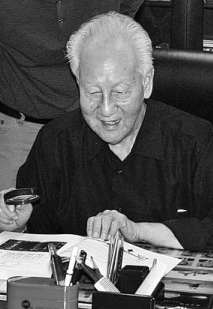
Researcher assisted on 1st nuclear submarine









When Huang Xuhua was selected to join the research team designing China's first nuclear submarine at the age of 32 in 1958, his director had a talk with him and made three things very clear.
One, "you are selected because the Party and the country trust you". Two, "this job is highly confidential. Once you enter this field of work, you won't be able to get out, even if you make mistakes". Three, "you will be unknown forever".
For the next three decades, Huang remained incognito and never returned home.
It was not until 1987, when a Shanghai magazine published a story about the life of the chief designer of China's first generation of nuclear submarines, that even his family name was mentioned publicly.
At the time, Huang never thought about being known to the public, let alone standing under the spotlight one day in the Great Hall of the People in Beijing and receiving the country's top science and technology award from the president.
Huang was born in 1926 in Guangdong province and graduated in 1949 from Shanghai Jiao Tong University with a degree in shipbuilding studies. The project to develop China's first nuclear-powered submarine was launched in 1958 and Huang was selected as one of the 29 researchers on the team.
However, China lacked the basic conditions to develop the submarine at that time. Huang said none of the 29 researchers had any knowledge in that field, and since other countries were extremely protective of such technologies, they barely had any technical reference materials.
To bolster the country's national defense capability and break the monopoly on nuclear submarine technology held by the United States and the Soviet Union, Chairman Mao Zedong urged China to develop its own vessels, even if "it would take 10,000 years".
Huang and his colleagues started by scouring newspapers and magazines for information.
"It was extremely difficult to find a little piece of information," he said. "The information was either too fragmented or hard to tell whether it was true or false."
They finally came up with five plans after piecing together all the information they found and carefully analyzing and studying two US submarine models.
"We believed the complex cutting-edge technologies were still based on basic knowledge," Huang said.
The team members didn't have any computers or digital calculators, so they used abacuses and rulers to solve problems. To ensure accurate calculation results, they were divided into three groups to do the math at the same time and would recalculate if the three values reached were not the same.
Their work continued, even when the project was suspended from 1962 to 1965, when China endured economic difficulties.
In 1970, China's first nuclear attack submarine underwent maritime tests. Named Long March No 1, it entered Navy service in 1974, making China the fifth nation to have a nuclear submarine.
In 1988, the vessel was ready for its initial dive test, a very dangerous task that had led to the sinking of the US sub Thresher in 1963 with all the crew in one of the deadliest submarine disasters in history.
Although the research team, the Chinese sub's manufacturer and the Navy overhauled all equipment and prepared comprehensive emergency plans for all operating systems and devices, many personnel still wrote farewell letters in the event of their deaths.
Under those circumstances, Huang, 62, decided to go onboard and participate in the test himself.
"As its chief designer, my feeling for the sub is like a father to his child. I not only love it, but also have full confidence in its quality," he told the crew."Plus I can assist the captain in time should any problem occur."
The sub reached its depth limit and Huang became the first chief designer in the world to be onboard a sub for its test dive.
Huang also directed the upgrading of the first-generation of nuclear submarines, greatly improving the vessels' combat capability, organized advance research and provided constructive suggestions on new generations of subs. He still goes to the research institute to work and chat with young researchers.
"I'm positioning myself as a cheerleader now," Huang said."I wave the flags, give cheers and support our younger scientists. When necessary, I can be their coach to offer some guidance."
Huang said he summarized his life in two words: obsession and joy.
"I have been madly obsessed with nuclear submarines in my life. It was my lifetime aspiration, with no regrets. And no matter how hard the life and work are, there is joy in pain," he said.
"Scientific research is boring, but it has infinite charm in the pursuit of truth and the unknown. There is endless joy once you can make a breakthrough."


Today's Top News
- Xi's inspiring messages to youth
- In China's healthcare gap, an AI doctor steps in
- Trump says US to begin guiding ships out of Strait of Hormuz
- Authority of Tokyo Trials 'must not be challenged'
- Beijing bans US sanctions on five Chinese cos
- Africa eyes benefits from tariff waiver





