



A wildfire warning the world cannot ignore









Australia is no stranger to wildfires. As a country, it is familiar with wildfires, wildfire management and the importance of wildfires in soil regeneration. Especially, Australia's indigenous people have known the importance of fire management and wildfires' contributions to ecosystems for hundreds of years. Yet 2019-20 is proving to be a nightmare for Australia, devastating in more ways than one could imagine. Simply put, the fires raging across Australia are unprecedented in ferocity, scale and level of destruction.
Authorities have been repeatedly appealing to residents in large areas of Victoria state to leave their homes, raising the "threat" level throughout southeastern Australia a couple of days ago, as they feared at least two major fires could merge. The fires have already swallowed an estimated 5 percent of Victoria.
Every state in Australia is facing a fire crisis, with New South Wales and Victoria being the worst hit. The total area burned is close to 8 million hectares, almost 10 times the area consumed by the Amazon fires in 2019.
The first major fires started in September 2019, that is, before the onset of spring, with the situation taking a turn for the worse at the beginning of November. And despite thousands of firefighters, including many from foreign countries, battling the fires, experts say they are unlikely to be controlled any time soon. Which means more destruction.
This is just to give a rough idea of the scale of the crisis in Australia, and the level of devastation the fires have caused. We have no idea yet of the overall consequences which, by all accounts, could be unprecedented.
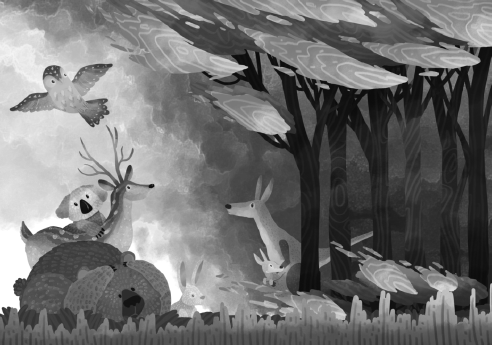
Some of the consequences are already evident, though. The bushfires have already claimed 26 lives. Millions of animals, birds, reptiles and insects have died. The cuddly koalas could become an endangered species, and Kangaroo Island, a safe haven for kangaroos, is under threat. Smoke from the fires has made air quality hazardous in many parts of Australia. Respiration-related illnesses, as reported by hospitals, have increased by 25 percent.
A Jan 1 image of Franz Josef Glacier in New Zealand showed the snowy mountaintops bathed in caramel brown thanks to the dust and ash from the Australian fires, although the distance between the glacier and the fires is more than that between Beijing and Hong Kong.
And a Japanese weather satellite has captured some striking images of the smoke plumes forming off the southeastern coast of Australia, which show the development of huge pyrocumulus clouds, a kind of smoke cloud seen during wildfires which can generate problematic weather, including lightning storms.
Indeed, Australia is facing a national crisis. But as US presidential candidate Bernie Sanders of the Democratic Party said on Jan 2, "What is happening in Australia today will become increasingly common around the world if we do not aggressively combat climate change and transform our energy system away from fossil fuels. The future of the planet is at stake. We must act."
True, climate change cannot start a wildfire, or any fire for that matter. But the effects of climate change can exacerbate bushfires.
And even though the link between wildfires-and frequent droughts alternated by heavy downpours, cloudbursts and floods; increasing high-intensity cyclones; melting icebergs and glaciers; and extreme winters and hotter summers-and climate change has become a dirty game between big businesses and climate change-skeptic politicians on the one side and climate scientists and environmental activists on the other, there is no denying the connection between rising greenhouse gas (GHG) emissions and changing weather patterns.
Perhaps the fact that Australia experienced its hottest year on record last year, with the temperature rising 1.5 degrees Celsius above the average according to a Bureau of Meteorology report, explains why the country is facing its worst wildfire crisis.
There is a tragic connection between wildfires raging across millions of acres and rising GHG emissions. Wildfires release carbon dioxide, a GHG, into the atmosphere. And although CO2 makes up only a small percentage of the total gases in the atmosphere, it has a remarkable quality of trapping heat. Australia's wildfires are estimated to have already released 350 million metric tons of CO2, which experts say need at least a century to be absorbed.
As Steve Pyne, an emeritus professor at Arizona State University, said, the Australian wildfires are a harbinger of things to come.
Don't ignore their warning.
But will the world act now, or will it keep bickering over the reality that climate change is while continuing its business as usual? That is something only world leaders and big business can answer.


Today's Top News
- China blasts rise of Japan's neo-militarism when marking Tokyo Trials anniversary
- China's action against unjustified extraterritorial sanctions is necessary and proportionate
- China blocks US sanctions on five Chinese firms over alleged Iran oil ties
- China assumes rotating presidency of the UN security council
- UN presses for talks amid recession fears
- Social safety net law to protect vulnerable





