



US incites violence by passing HK laws









Editor's Note: US President Donald Trump signed two bills into law on Wednesday, rendering support to those trying to create chaos, including the rioters who have wrecked havoc, in the Hong Kong Special Administrative Region. Two experts share their views on the issue with China Daily's Liu Jianna. Excerpts follow:
Legislation hurts bilateral relations
This is a critical time in Sino-US relations as the United States has used state power to interfere in China's internal affairs and undermine its sovereignty by passing the so-called Hong Kong Human Rights and Democracy Act, which in essence is more like a second "Taiwan Relations Act". The other law bans exports of mob control equipment, including tear gas, pepper spray, rubber bullets and stun guns, to Hong Kong police.
China has strongly protested against the US meddling in Hong Kong's and thus China's internal affairs on the pretext of human rights protection.
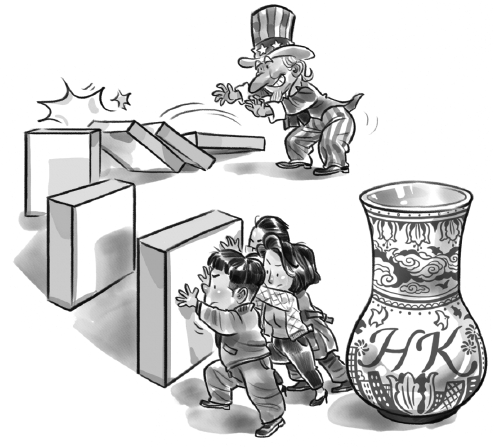
By passing the bills, the US is encouraging the demonstrators in the SAR to continue the mayhem so as to weaken its financial market and smear its image as a global financial center. The two bills have dealt a blow to bilateral relations of the two countries. And by continuing to interfere in China's internal affairs and undermine its sovereignty, the US will further undermine bilateral ties.
China should, therefore, be prepared to face a long-term complicated and challenging relationship with the US. It comes as no surprise that the US leader signed the bills, as they got near-unanimous support in both chambers of the Congress-which means US domestic politics played a key role in the passage of the two acts.
About 85,000 US citizens live in Hong Kong and 1,300 US companies operate there. The Hong Kong issue has become one of political correctness in the US, and is thus imposing huge pressure on the US administration. No politician can afford to remain silent. And Washington has taken a provocative stance.
The situation in Hong Kong would further deteriorate, its economy might suffer a big blow, and the regional economy would get bogged down if the Sino-US trade talks fail.
Which means the trade talks are vital to not only the two economies, but also the regional and global economies. So as a responsible major country, the US should refrain from mixing the trade talks with the Hong Kong issue.
Attempt to sabotage SAR's development
The Hong Kong Human Rights and Democracy Act should be strongly condemned, because it is a blatant interference in China's internal affairs and violation of international law. The US has again extended its long arm to meddle in a sovereign country's domestic affairs, which cannot be tolerated.
That the US' aim is to impose sanctions on Chinese officials and enterprises that get in its way once again exposes its blind adherence to unilateralism and exceptionalism-in other words, hegemonism.
To be sure, the two bills will have profound negative impacts on China-US relations.
The shadow of Western capital and a number of foreign leaders, mainly those from the US, was evident in the Hong Kong District Council election on Nov 24. And since the US president is facing rising opposition at home, he is trying to meet both ends to ease the pressure by mixing the trade talks with the Hong Kong and Xinjiang issues, and the Taiwan question.
The US has targeted Hong Kong not only because of ideology and alleged violation of human rights and democracy in the SAR, but also, and more importantly, because it wants to slow China's rise by curbing the global financial hub's role as "bridge" in the Guangdong-Hong Kong-Macao Greater Bay Area, the Belt and Road Initiative and the internationalization of the renminbi. It wants to make Hong Kong a piece on its chessboard to keep China in check and serve the vested interests of the US and the West.
So China should be strategically prepared to endure the long-term complicated relationship with the US.
The views don't necessarily represent those of China Daily.




Today's Top News
- UN presses for talks amid recession fears
- Social safety net law to protect vulnerable
- US' proposed curbs on Chinese entities opposed
- Zero-tariff policy opens door wider for African imports
- Respect for honest labor emphasized
- China asks US to revoke restrictive steps against telecom carriers





