



Hawking collaborator to visit China to discuss physicist's work









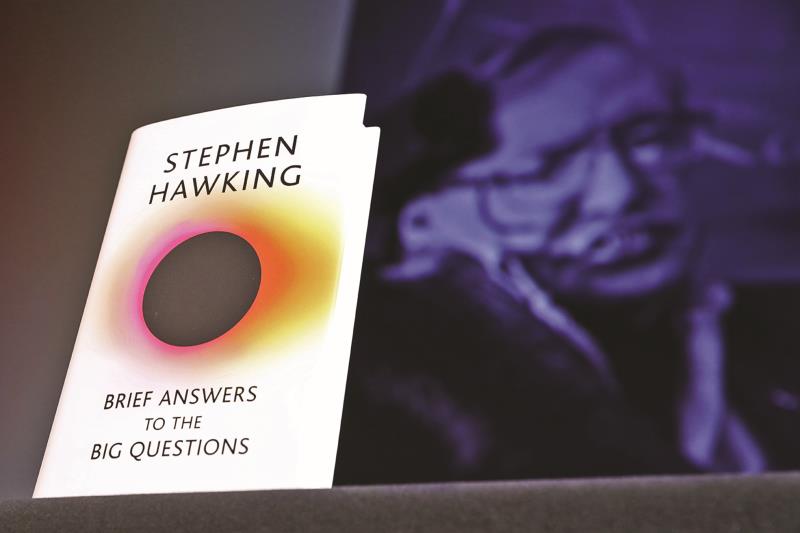
One of Professor Stephen Hawking's closest collaborators said he is going to China in January to talk about the eminent physicist’s final academic research.
Hawking, arguably the world's most famous scientist of his generation, died in March at the age of 76 after many years of living with debilitating medical condition motor neurone disease.
His final academic paper, dealing with the question of whether black holes preserve information on the material that falls into them, was published last week. Speaking at the launch of a new book of Hawking's final writings, Brief Answers to the Big Questions, collaborator Professor Malcolm Perry said Chinese academics had been the first to get in touch.
"Stephen went to China a number of times," he explained. "He was enthusiastic about explaining science to anyone who would listen, and, as China is becoming the economic powerhouse of the world, it's somewhere that was particularly important – it's where the future lies."
Cambridge University academic Perry and Harvard's Professor Andrew Strominger worked closely with Hawking on his final paper. Strominger said even though it had only been out for one week, one of his former students, Professor Wei Song at Tsinghua University, was already leading academic discussion of the paper and, even before it was published, had invited Perry to talk about it. Details of the visit are not yet finalized.
Perry and Strominger were speaking at the launch of the book at London's Science Museum, along with Hawking's former student, Professor Fay Dowker of Imperial College London.
Brief Answers to the Big Questions, which is due to be published in China by Hunan Science and Technology Publishing House, was Hawking's attempt to give definitive answers to some of the questions most frequently asked by readers of his 1988 bestseller A Brief History of Time.
The publication of his final academic paper and book at the same time was coincidental, but they have combined to put his name and work back in the spotlight.
Dowker said that while the book was an attempt to bring things to a close, the nature of scientific research meant that this was not the case with his final paper.
"It's never about closing, it's always about opening," she said. "When you make a discovery, new questions arise which you could never have thought of before. You can settle a particular question but it changes the world around you. Stephen left us with a question, and it is one that I hope will bear fruit."
Strominger added: "It's hard for the non-scientist to understand how much work goes into research. You don't just write a few lines and sew the whole thing up. I think Stephen was very optimistic that when it was completed, it would somehow be the culmination of his life's work, but were he still alive, he would agree there are more papers to follow."
Hawking's colleagues also paid tribute to Hawking as a man they remembered warmly, professionally and personally.
"There was never a barrier between the lowly student and high flying supervisor – the atmosphere he created in our study group was that science was the most important thing, so everything else was secondary," said Dowker.
Strominger said he was "unrelentingly positive" about the subject and the future.
"He believed we could solve problems, and radiating that motivated and inspired a lot of people, myself included," Strominger added.
Hawking's death robbed the scientific community of not only one of its greatest brains, but also its most public advocate. Strominger said keeping Hawking's spirit alive would be one of the greatest challenges to those who come after him.
"Applied science – making things where there's a clear economic motivation – is being well funded, but Stephen was a great advocate of basic curiosity-driven science, finding out how and why things are, independent of how much money it will make," he explained. "He was a great mouthpiece for that, and also for the importance of the human spirit being interested in, and trying to understand, the everyday world around us. I don’t know if there'll be anyone quite like him for that."










