Carving out a career in restoration









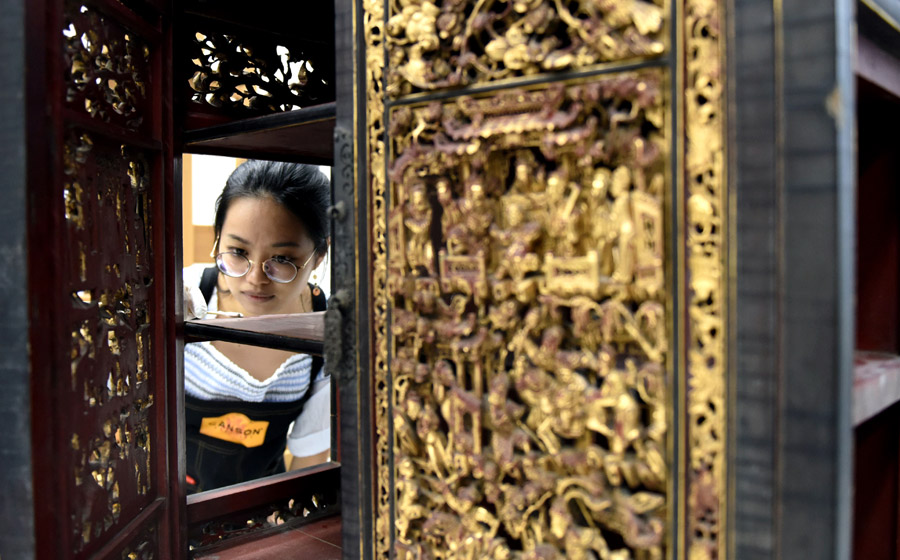
Li Ziying dips a cotton swab in a glass of water, and carefully swipes it across the surface of a wood carving. Then she removes the cotton tip, dries it and puts it in a plastic bag.
The plastic bag is documented and archived, and Li, 22, sits down to go through the process once more.
Li is a senior student at the Guangzhou Academy of Fine Arts and works in a studio at the academy dedicated to restoring Chaozhou wood carvings.
The wood carving style is from Chaozhou, in South China's Guangdong province. Dating back to the Tang Dynasty (618-907), it was listed as national intangible heritage in 2006.
The high humidity in South China means wood decays easily, and many Chaozhou wood carvings are not in good condition. Art students like Li work as assistants to restore pieces.
Restoring artifacts became well known in China with the popularity of a 2016 documentary made by State broadcaster China Central Television about the life and work of restorers in Beijing's Palace Museum.
"When people know we are restoring ancient artifacts, their first response is always, 'That's cool'. But it's actually very tiring work," Li said.
The process is time-consuming: Using ultraviolet light to check the condition of the items, clearing the surface with special tools, gathering dust and fallen parts, categorizing them, repainting, taping parts and reinforcing the carving.
It can take hours or even days to finish one piece, and the restoration standard is high. Li and her colleagues sometimes work until 10 pm.
Li used to restore old oil paintings at the academy, but she said the process of restoring ancient wood carving is completely different.
Dust, wood fragments, cotton from the swab and even the shells of dead insects on the carvings need to be stored and categorized for research.
"Each part of the carvings contains information," Li said. "We cannot miss anything."
The long working hours and meticulous process have not scared away Li and her colleagues, as they have gradually developed a different view of the ancient wood carvings.
"Now when I see the carvings, it's like a doctor seeing a patient," she said. "I feel their pain and just want to fix them as quickly as possible."
She has been working in the studio for a year and loves her job, with her skills recognized by teachers, who recommended her for a place at an art school in Avignon, France, to study art restoration. She will head to Europe in August.
"I hope to make it my career," Li said.
Xinhua




- Between wetlands and worlds: The story of a Bangladeshi student in China
- China's 5G base stations top 4.83 million by end of 2025
- Peaceful reunification to offer socio-economic benefits for Taiwan
- China records success in reversing ecosystem degradation
- Immigration bodies investigated nearly 19,000 criminal cases in 2025
- First-time Taiwan applicants for mainland travel permits surge over 57%