



China's migrant population shrinks by 1.7 million









China's population of migrant workers saw a decline for the second consecutive year in 2016, to 245 million, according to a report released by the National Health and Family Planning Commission on Nov 10.
Last year, China's migrating population decreased by 1.7 million from 2015, the report said.
Before 2015, the group had been growing, from 230 million in 2011 to a peak of 253 million in 2014, the report said.
Despite the decrease, the migrant population still accounts for a big share of China's total, and the number will remain at a high level over the long term, it said.
The total population of the Chinese mainland exceeded 1.38 billion as of the end of last year, an increase of more than 8 million over the previous year, according to the National Bureau of Statistics.
Over the past six years, the proportion of all migrants who moved across provinces declined from nearly 70 percent in 2011 to less than 64 percent last year, while the percentage of those migrating to different cities within the same province rose from about 25 percent in 2011 to more than 27 percent last year, the report said.
Meanwhile, the average age of migrants rose from 27.3 years to 29.8 during the same period. The monthly income of migrant workers increased by 15 percent annually, on average, between 2014 and last year, the report said.
The drop in numbers over the past two years is largely the result of major policies issued by governments to encourage migrants to settle down in the cities where they work, says Wang Qian, the commission's chief supervisor of the migrating population.
Some cities have set limits on total population in recent years, which has led to a decrease in migrants, he says.
In Beijing, the total number of migrants declined by more than 150,000 last year from 2015, according to a report released in September by Beijing University of Technology.
Despite the drop in the migrating population over the past two years, one trend has not changed, Wang says: Migrants tend to flow to large city clusters along China's coasts, major rivers and railways. And they tend to take the whole family.
"Increasing whole-family migration will place more demand on public services such as education and healthcare," he says. "We will take this into consideration in providing healthcare and family planning services."
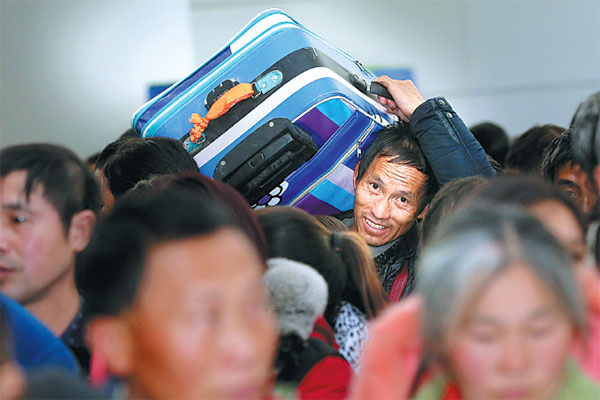
| Migrant workers line up for a train in Urumqi, Xinjiang Uygur autonomous region, on Nov 13. A total of 1,823 workers, many of them seasonal cotton harvest hands, recently completed their employment in the region and set off for home on a train that was scheduled especially for them. Li Xiongxin / For China Daily |
(China Daily European Weekly 11/17/2017 page15)


Today's Top News
- Upholding remembrance of the Tokyo Trials, a litmus test of?humanity's conscience
- Xi calls on youth to align personal pursuit with national progress
- China says renewing backdrop, conclusion, principles of Tokyo Trials all the more relevant
- China blasts rise of Japan's neo-militarism when marking Tokyo Trials anniversary
- China's action against unjustified extraterritorial sanctions is necessary and proportionate
- China blocks US sanctions on five Chinese firms over alleged Iran oil ties





