



Experts retrace ancient trade links









Scientists gather to discuss voyages centuries ago that laid the foundations for China-Africa connection
Scientists from the "global south" - Africa and most of Asia - were expected to arrive at Kenya's coastal town of Lamu this week to probe and understand the holistic impact of globalization by retracing the footsteps of sailors who landed along the coast of East Africa hundreds of years ago.
The conference, from July 27 to 29, is the first of its kind and was due to examine the presence in East Africa 600 years ago of seafarers led by Admiral Zheng He, also revealing Africa's proactive contribution to global commerce at that time.
Chapurukha Kusimba, a Kenyan anthropologist based in the United States, says about 25 researchers from various geographic areas that were part of the ancient and historical Indian Ocean and South China Sea trade networks were due to participate.
Discussions would be evidence-based, he says. At least 16 scientific papers were due to be read during the conference.
"This information will contribute to the knowledge repository already in existence detailing the history of China-Africa trading relations. It will assist countries in making informed decisions that are not influenced by a negative narrative," he says.
It is believed that Kenya's coastal waters hold a sunken ship that was part of a mighty fleet commanded by Zheng during the Ming Dynasty (1368-1644). The armada reached Malindi in 1418.
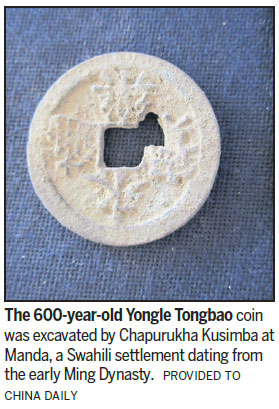
"It is known, based on evidence at sites here, that there was vibrant interaction between Chinese and Africans," says Kusimba. "It is critical to justify this evidence, which will be a firm springboard from which China and Africa can base their relations in the future."
Kusimba, a professor of anthropology in Washington, DC, says the earliest documented trade links between East Asia and the Mediterranean date to around 2,000 BC.
"Africa has been left out of the analysis of these early connections. Consequently, its contribution to early globalization remains under-theorized and often misrepresented. By focusing on the theme, Ancient and Contemporary Relations Between China and East Africa, the conference hopes to illuminate our understanding of early networks of interaction along the Maritime Silk Road during the first and second millennia and how these interactions impacted, and continue to influence, Sino-African relationships," he says.
The scientist has been involved in a seven-year project in Lamu between Kenya - through the National Museums - and scientists from Sun Yat-sen University, Guangdong province.
He says the intention of the meeting was to facilitate the exchange of scholarly information in a setting that encouraged not only the presentation of ideas but also discussion of how to do further research through international collaboration, involving experts from different fields as well as students of anthropology, history, art, chemistry, geology and geography. He says it was hoped to build a platform where young researchers would benefit from being mentioned by advanced scholars.
Kusimba says excavations in East Africa employed six young researchers - three Chinese, one Kenyan studying in China and two Americans. The digs have revealed that the coastal communities were innovative and resourceful in trading with the Chinese, Portuguese and Arabs.
"Fruits such as bananas passed through here. Cereals such as sorghum and millet were domesticated here before being traded. There was robust trade between Africans and their counterparts," he says.
Despite not becoming a formal term until the latter part of the 20th century, Kusimba says globalization is a central concern of anthropology and other disciplines that focus on understanding cross-cultural interactions and survival strategies developed through cooperation and competition, as well as isolation and integration.
The Kenya meeting comes at a time when there is heavy discourse around the subject of globalization. President Xi Jinping has been a strong champion of free trade, as exemplified by his speech at this year's World Economic Forum in Davos. The United States, however, appears to be stepping back from globalization and turning inward.
lucymorangi@chinaafrica.co.ke
(China Daily Africa Weekly 07/28/2017 page28)


Today's Top News
- Xi urges all-out rescue work after fireworks plant explosion causes heavy casualties
- Standoff deepens in Hormuz
- Gig economy, digital platforms teaming up to reshape work
- TV makers putting on big show abroad
- 'One-person companies' taking economy by storm
- Privately backed nuclear plant a crucial milestone





