EU, China advance amid global uncertainty









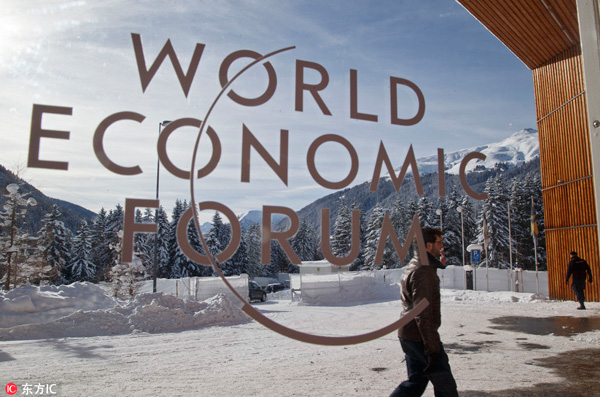 |
| A man walks at the main entrance of the congress center where the World Economic Forum takes place in Davos, Switzerland, in this file photo taken on Jan 18, 2016. [Photo/IC] |
When President Xi Jinping addresses the world's business and financial elites on Tuesday, he will have an opportunity to demonstrate China's commitment to globalization.
In light of the worrying, uncertain and often contradictory messages emanating from Trump Towers in recent weeks, political and business leaders attending Davos will ask each other just what US president-elect Donald Trump means for global political, economic, security and trade policies.
Trump's questioning of the existing multilateral economic system places a special responsibility on China and the EU. Both share a steadfast commitment to the centrality of the United Nations system, maintaining free trade, upholding the Paris climate change agreement and tackling regional security issues such as the Iran nuclear deal.
Trump is on record questioning the value of free trade, and has said he will drop the Trans-Pacific Partnership agreement and renegotiate the North American Free Trade Agreement.
He has also threatened China with new tariffs contrary to World Trade Organization rules. He has scoffed at the UN and international institutions in general. He has said that he is not convinced of the evidence about climate change. He has also said that he intends to tear up the Iran agreement and reverse the recent United States opening to Cuba.
On all these issues, Beijing and Brussels have more in common with each other than with the incoming US administration. It is important that Chinese and the EU leaders make common cause to save the multilateral system from opposing forces in the US.
One cannot expect too much on the bilateral front in 2017 with both China and the EU preoccupied with internal issues. An additional priority is steering the Chinese economy to a soft landing after the heady years of double-digit growth.
For the EU, it is awaiting the outcome of elections in France, Germany and the Netherlands, and especially how the populist parties such as the Front National will perform in France. Migration remains a priority issue and the problems surrounding Brexit are just beginning.
But there are ongoing opportunities for the EU and China to deepen their relations this year. For example, there are the negotiations for a bilateral investment agreement which would provide increased market access and legal certainty for business.
There is also huge potential for cooperation in the Belt and Road Initiative (the Silk Road Economic Belt and 21st Century Maritime Silk Road) as China seeks to support transport, energy and infrastructure projects linking Asia and Europe. The EU has expressed its willingness to engage with the Belt and Road Initiative and the two sides are now discussing concrete proposals for joint support.
Both sides can leverage the Asian Infrastructure Investment Bank to support much needed development projects through Asia. They could also work together to help the Association of Southeast Asian Nations achieve its economic integration plans.
Another important area for cooperation is Africa where there is considerable potential for the EU and China to cooperate in conflict prevention and peacekeeping. China is displaying a greater readiness to become involved in UN peacekeeping missions and is planning a standby force of 8,000 troops. The EU is the main supporter of the African Union and its peacekeeping activities. The two sides are already working together off the coast of Africa in anti-piracy maritime operations.
A EU-China summit is scheduled for the summer but there will also be a number of meetings at the ministerial and senior-official levels to prepare the ground and discuss opportunities for cooperation in new areas.
In a fast-changing and uncertain world, the EU and China are two much needed pillars to support the multilateral system.
The author is the director of the EU-Asia Centre.