



US 'wants China's to succeed in its reforms'









Imagine that a crew of riverboat has been navigating in relatively calm water for 30 years, but now it is moving towards rapids with risks and challenges from both inside and outside the vessel. People ask: Are they going to reach the other side?
The metaphor was brought up by Matthew Goodman, William E. Simon Chair in political economy at the Center for Strategic and International Studies (CSIS) in Washington. He nicknamed the project on economic decision-making in China "the navigator" during Tuesday's multimedia presentation China's Economic Policymaking at a Time of Transition.
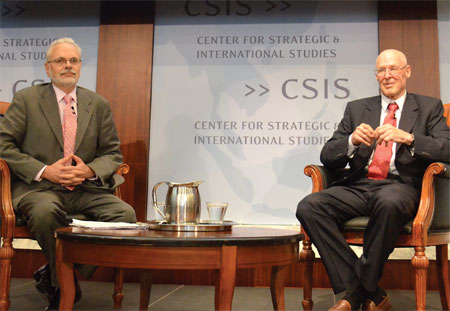
The event marked the halfway point of a two-year-long project on economic decision-making in China. The presentation was followed by a conversation betweenHenry M. Paulson Jr, 74th secretary of the Treasury and chairman of the Paulson Institute, and David Wessel, director ofHutchins Center on Fiscal and Monetary Policy at the Brookings Institution.
"China has clearly entered a period of slower growth, and risks and challenges for policymakers have increased. This presentation is all about whether this group of policymakers has or still has the right stuff to manage this transition to a new model of economic growth and development," said Goodman.
According to the panel, China's economy has grown rapidly for 30 years due to a combination of smart politics and favorable economics. Nearly unlimited supply, inexpensive labor, high saving rate, massive investment, large growing export markets and the pursuit of rapid economic growth contributed to the economic boom as well.
Now, however, these advantages are gone. China faces the middle-income trap.
According to Reuters, China's full-year growth in 2013 was 7.7 percent, slightly above market expectations of 7.6 percent. As the world's second largest economy, China is facing both risks and challenges.
"Despite the strong preference for top-down oversight, coordination remains a major challenge to Beijing," Goodman added.
Government ministries have been streamlined with 100 in 1982 in contrast to today's number of fewer than 50. Drawbacks exist, such as the jurisdictional overlap and the gap between the center and localities, according to the panel.
Decentralized governance has benefited China's development tremendously. Local leaders have competed intensely and creatively to meet central targets. These targets, especially GDP growth, determined officials' promotion prospects and created powerful incentives to comply with Beijing.
Decentralization has filled unproductively over investment and massive buildup of local debts, he explained.
The panel acknowledged China's inevitable difficulty. As they said that the size and complexity of China's economy and its interdependence with global economy makes managing external dynamics far more complicated.
The panel said that Chinese leaders have to balance multiple objectives in addition to GDP growth, for example, clean air, safe food and clean governance.
Henry Paulson said: "We want China to succeed in reforms." He believed that Chinese people care about corruption, clean air, clean water and food security and believed with no doubt that they are "serious about curbing corruption".
Distinguished panelists at the event included Christopher K. Johnson, senior adviser and Freeman Chair in China Studies, CSIS;Matthew P. Goodman, William E. Simon Chair in Political Economy, CSIS;Kevin G. Nealer, principal of the Scowcroft Group;Olin Wethington, former assistant secretary of the Treasury for international affairs and special envoy to China; andDavid Dollar, senior fellow at the Brookings Institution and former treasury and World Bank representative in China.
changliu@chinadailyusa.com
| Center for Strategic and International Studies held a presentation on China's Economic Policymaking at a Time of Transition on Tuesday. The presentation is followed by a conversation between Henry M. Paulson Jr (right), 74th secretary of the Treasury and chairman of the Paulson Institute and David Wessel (left), director of Hutchins Center on Fiscal and Monetary Policy, Brookings Institution. Liu Chang / China Daily |
(China Daily USA 04/16/2014 page2)


Today's Top News
- Xi's inspiring messages to youth
- In China's healthcare gap, an AI doctor steps in
- Trump says US to begin guiding ships out of Strait of Hormuz
- Authority of Tokyo Trials 'must not be challenged'
- Beijing bans US sanctions on five Chinese cos
- Africa eyes benefits from tariff waiver





