|
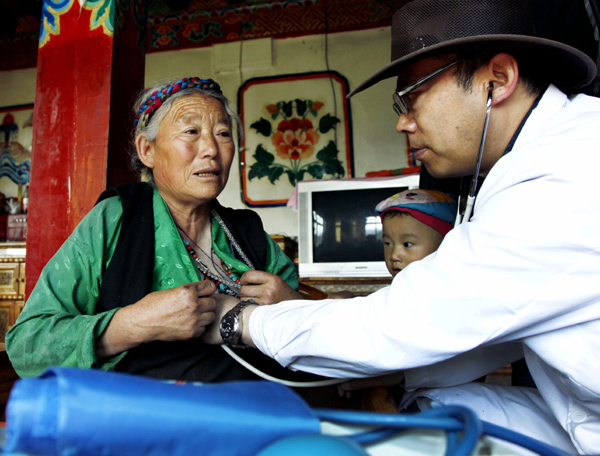 |
| Adoctor with the Aid-Tibet program from Tianjin checks a patient in Qamdo county of the Tibet autonomous region. Pan Xu / Xinhua |
|
|
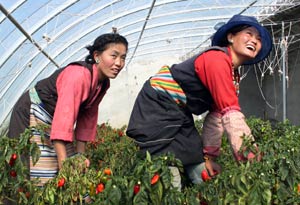
Since 1995, Hebei has sent 223 people to the county and invested more than 10 million yuan in the county's vegetable farming. Tashi said he grows watermelons and cucumbers in his greenhouses. The crops have become popular products among the locals.
Over the past three years, the price of green-leaf vegetables has also dropped from 13 yuan per kilogram to 8 yuan.
"Because of working in the high-altitude environment, my teacher had two heart attacks while he was in my county," Tashi said. "I really appreciate the sacrifice they've made to Tibet."
The aid program includes tests of administrative skills, professional knowledge and common knowledge of Tibet that are set once every three years to select the most capable participants for deployment to the region.
Program participants typically fulfill stints from one and a half years to three years. They are offered subsidies during their work in Tibet and most of them are promoted when they return home.
Tibetans like Tashi said they learn many skills from the program specialists and pass them on to other residents. Over the past three years, he has taught 324 villagers how to grow vegetables in greenhouses.
"The aid is like a blood transfusion, but our ultimate goal is help the locals produce blood by themselves," said Wu Haifeng, a 39-year-old physician from Heilongjiang province. He has taught two students who are able to carry out basic surgery independently.
Wu, a general practitioner, brings the latest medical skills to the area, said Jamyang, one of the two students and an anesthetist in the county hospital. Citing an example, Jamyang said the new treatment he learned for treating varicose veins in the lower limbs leaves a smaller wound and hence less pain.
"We used to cut the whole limb open but now we only make a small opening," he said. "As a doctor, I am so proud to see my patients suffering less."
The lack of doctors means locals had to travel more than 100 kilometers to a bigger hospital if they suffered fractures, and many heavy patients could not make the trip, Jamyang said.
The local government has built a hospital with a national standard surgery room and 70 beds, Jamyang said. After Wu arrived, the hospital's occupancy rate grew from 10 percent to 90 percent.
Tibet is enjoying more of such infrastructure and facilities after decades of development, Jamyang said.
"Now we need more talented people," he said.
Contact the writer at pengyining@chinadaily.com.cn

Copyright 1995 - . All rights reserved. The content (including but not limited to text, photo, multimedia information, etc) published in this site belongs to China Daily Information Co (CDIC). Without written authorization from CDIC, such content shall not be republished or used in any form. Note: Browsers with 1024*768 or higher resolution are suggested for this site.
License for publishing multimedia online 0108263 Registration Number: 130349