Latest News
Japan site still leaking, source unclear
(Agencies)
Updated: 2011-03-23 07:02
 |
Large Medium Small |
|
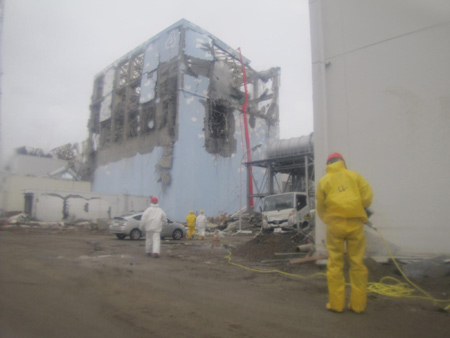 Efforts to spray water into the No. 4 reactor at the Fukushima Daiichi Nuclear Power Plant, which was struck by an earthquake and tsunami in Tomioka, Fukushima Prefecture, northeastern Japan, are seen in this March 22, 2011 handout photograph released by Tokyo Electric Power Co. . Picture taken March 22, 2011.??[Photo/Agencies] |
VIENNA - Japan's disaster-hit nuclear power plant is still emitting radiation but it is unclear where exactly at the site it is coming from, a senior UN atomic agency official said on Tuesday.
The International Atomic Energy Agency (IAEA) also said it had continued to receive data from Japan confirming "high levels of radioactivity" in food, notably spinach, at locations south of the crippled Fukushima Daiichi nuclear complex.


"We continue to see radiation coming from the site ... and the question is where exactly is that coming from?" senior IAEA official James Lyons told a news conference.
"Is it coming from the reactor units' primary containment vessels or from the spent fuel pools?"
He said he believed there were no "large holes or excessive releases" at any of the plant's first three reactor units, but it was also not confirmed that their containments were totally intact.
At the site on Tuesday, rising temperatures around the core of one of the six reactors sparked new concern and more water was needed to cool it down, the plant's operator said.
Despite hopes of progress in the world's worst nuclear crisis in a quarter of a century, plant operator Tokyo Electric Power Co (TEPCO) said it needed more time before it could say the reactors were stabilised.
Food Radiation Concerns
"There continue to be some improvements at the Fukushima Daiichi nuclear power plant but the overall situation remains very serious," Graham Andrew, another IAEA official, said.
He said the IAEA had not received validated information for some time about about the "containment integrity" of the plant's No.1 unit and it was concerned it did not know its exact status.
"It would be particularly valuable to have data about the damage which has been suspected to that containment integrity ?and the core and fuel integrity," Andrew said.
"Has there been melting? Is it buckling?"
He said he did not think the Japanese were holding back data but rather that they simply did not have it themselves.
Japanese media reported on Tuesday that lighting had been restored at one of the control rooms, bringing the operators a step closer to reviving the plant's cooling systems.
Earlier smoke and steam were seen rising from two of the most threatening reactors, No 2 and No 3, threatening to dash hopes of progress in bringing them under control.
Mounting evidence of radiation in vegetables, water and milk in areas near the plant has also stirred concerns, despite officials' assurances that the levels were not dangerous.
"The agency continues to receive data confirming high levels of radiactivity in food, notably spinach, in samples taken from 37 locations in the vicinity of five cities to the south of the Fukushima site," Andrew said.
"This indicates that in four prefectures some food products are above permissible levels," he said.
High levels of both iodine 131 and caesium 137 were being measured by the Japanese authorities in spinach and some other fresh vegetables together with iodione 131 in milk, he said.
Japanese authorities have already stopped shipments of milk and some vegetables from the area.
Minuscule numbers of radioactive particles believed to have come from Fukushima have been detected as far away as Iceland, officials said on Tuesday.
| 分享按鈕 |