Top News
Haiti slowly getting back on its feet
By Chen Weihua and Huo Yongzhe (chinadaily.com.cn)
Updated: 2010-01-21 22:30
 |
Large Medium Small |
PORT-AU-PRINCE: It is 4 am Thursday morning, Paul Cabrera and two of his co-workers were just coming back from the airport and unloading some two dozens of boxes of medical supplies on the ground outside where they live.
|
 A French doctor examines a baby in Jacmel, a town on the south coast of Haiti, January 20, 2010. [Agencies]? |
Cabrera, a Mexican working in Barcelona, Spain, has been coordinating the work for Doctors Without Borders from Spain for the past week.
"Most doctors work 14-16 hours a day," he told China Daily.
Under such an intensive workload, the doctors will be replaced after two to three weeks, according to Cabrera.
Doctors Without Borders from France, Belgium and the Netherlands had a large presence in Haiti before the earthquake, providing medical service to poor Haitians in its three hospitals. But all of them are either damaged or not stable for use.


"The facilities are far from adequate and I don't even know how many patients I have to treat every day," said Fernanda Falero, a doctor from Uruguay who arrived the second day after the quake.
Cabrera and Falero are just two among numerous relief workers racing against time in Haiti, after the devastating earthquake on January 12 killed an estimated 200,000 people.
Eight days after the earthquake, on the roads from Port-au-Prince to the Dominican Republic border, ambulances with patients and trucks loaded with relief materials are the most noticeable, causing traffic jams.
With much similarity with China's Sichuan earthquake, the rescue operation in Haiti is expected to enter into a difficult and prolonged reconstruction.
Although many people's homes have been turned into rubbles and signs of poverty are everywhere on the streets, some people are trying hard to get back to their normal lives.
Three men were mending their slightly damaged house along a major road to Port-au-Prince.
In a playground near several collapsed buildings, groups of children were seen on Wednesday of flying kite and playing soccer. A young man and woman were dancing outside the horse.
|
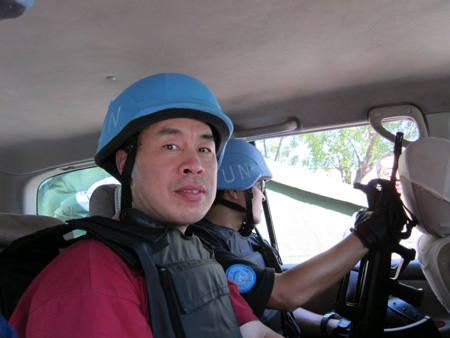 China Daily reporter Chen Weihua [chinadaily.com.cn]  |
The Caribe Tours still operates daily routes between Port-au-Prince and several other Haitian cities to Santo Domingo in Dominican Republic.
Vendors are also seen along street sides selling fruits and snacks.
But the thing missing is clearly water. Several school children were fighting for a bottle of?water on the street, while a long line was formed in front of well, with people carrying makeshift buckets.
The extreme heat and humidity in daytime Port-au-Prince, with temperature in the sunshine soaring to 40 degrees centigrade, has made the challenge of water much more serious.
Outside a supermarket in the Duval area of Port-au-Prince, two men holding guns stood on guard, letting customers to enter one at a time.
It seems that only the rich can afford to shop in such a supermarket these days. The rich and poor disparity in Haiti is among the highest in the world.
In the Petionville area, an upper-class neighborhood, restaurants and hotels are still operating, although serving a limited menu.
|
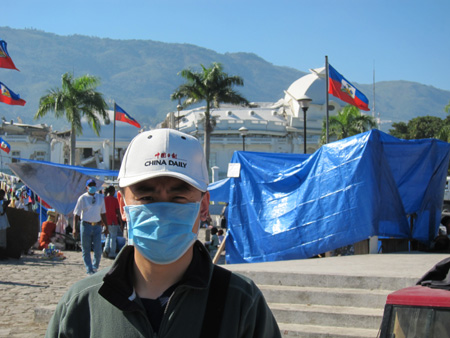 China Daily reporter Huo Yongzhe [chinadaily.com.cn] |
Many Westerners and Western aid groups, including Doctors Without Borders, have found temporary homes in this area.
Emile Castonguay, a Canadian actor and film director, came from Montreal. He is going to help his would-be parents-in-law and sister-in-law move to Canada after they lost their home during the earthquake.
He also hopes to find two children, whose parents, both working for Castonguay, were killed during the earthquake.
Joyce Joseph, the sister-in-law, was fortunately outside the house when her home collapsed. But her aunt was killed during the disaster a week ago.
Castonguay and his Haitian girlfriend, who are deeply involved in Haitian art and film festivals in Montreal, where more than 100,000 Haitians live, have also worked hard to push the Canadian government to speed up immigration process for Haitian victims into Canada.
Under the efforts led by him and his girlfriend, some Canadian telecom companies are providing free international long distance calls to Haitians.