BRICS contributes to economic growth, citizen welfare: Russian deputy PM


 |
|
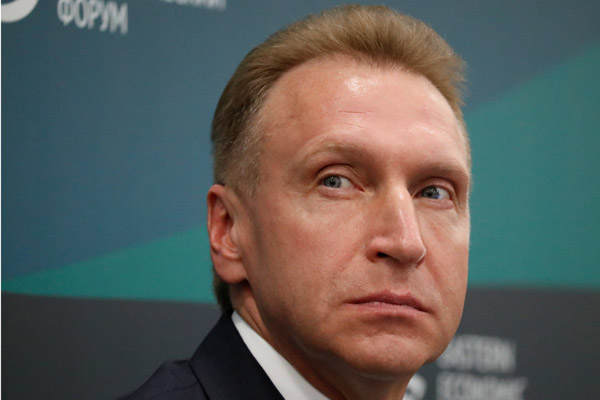
Russian first Deputy Prime Minister Igor Shuvalov attends a session of the Eastern Economic Forum in Vladivostok, Russia, Sept 6, 2017. [Photo/Agencies] |
VLADIVOSTOK - BRICS's economic agenda is helping to build a new system for innovation, which will improve the welfare of citizens and boost economic growth of the bloc's members, Russian first Deputy Prime Minister Igor Shuvalov has said.
"By and large, the economic agenda of BRICS will help us to build an entirely new innovation system, at times differing from those imposed standards that our partners have, an economic system that will be both sovereign and, at the same time, permeated with integration. And this will allow our citizens to improve their welfare ... allow us to develop our economy," Shuvalov told Xinhua in a recent interview.
Shuvalov said during the Third Eastern Economic Forum here on Sept 6-7 that BRICS, which groups Brazil, Russia, India, China, South Africa, is at "a serious stage of its formation" and that it takes time to build a big, powerful organization.
"From what we see, the leaders are determined to move forward in accordance with this plan," he said.
Currently, the BRICS New Development Bank has started operation, and will be able to work in national markets with national currencies, according to Shuvalov.
"We hope other institutions will also emerge in the process of cooperation to strengthen monetary interaction," he said.
The EEF was held following the closure of the BRICS summit held in the Chinese city of Xiamen from Sept 3 to 5.
Speaking of Russia's economic ties with China, Shuvalov said that the two countries have an enormous bilateral trade, and that China's high economic growth rate will also help to boost Russia's economy.
Furthermore, the Belt and Road Initiative and the Eurasian Economic Union are integrating with each other, which should also increase the volume of mutual trade between the two countries, he added, listing high technologies, raw materials, cultural and humanitarian exchanges, and scientific developments as promising areas for cooperation.
In this sense, Shuvalov believed that it is possible for the two sides to reach the trade goal of 200 billion US dollars by 2020, despite some negative factors.
"This is an ambitious task...We see opportunities for such a trade to develop, and this target of 200 billion dollars, of course, is not the limit. This goal can be achieved...It's hard to do, but it is possible," he said.
For this purpose, China and Russia should carry out a string of measures such as eliminating barriers to the movement of goods and investment between the two countries, enhancing trade facilitation and encouraging settlement in domestic currencies, he suggested.
The deputy prime minister said although he believes there's great opportunity across his country, Russia's Far East bears the rosiest prospects for China with its multiple advantages, including geographic proximity, rich natural reserves and excellent infrastructure facilities, allowing it to develop faster than any other region in Russia.
"Here Chinese investors have the opportunities to engage in agriculture, equipment infrastructure, joint projects in science and education, and we already see some joint ventures or enterprises in which China buys a stake or part of the shares. We encourage this," Shuvalov said.
Over recent years, the Russian government has invested massive financial resources and introduced favorable policies into the region, so as to enhance its competitive edges and investment attractiveness.
Currently, the economic growth rate in the Far East has is 4.2 percent, and fixed capital investment has increased by nearly 20 percent in the first half of this year, Russian President Vladimir Putin said at the EEF's plenary session on Thursday.
More than 200 contracts with a total value of over 2.4 trillion rubles ($42.1 billion) were signed at the two-day forum this year, according to its organizing committee.
Starting in 2015, the EEF aims to improve relations between the international investment community, Russian businesses, and Federal and local governments while presenting the competitiveness and favorable conditions for investment in the Russian Far East region.
This year, more than 700 business representatives from 55 countries including China, India, Japan, Vietnam, Australia, Canada, the United States and Britain were present at the forum.