


Adaptation needed in Sino-German partnership
By Winfried Bostelmann ( China Daily ) Updated: 2016-03-24 08:06:19
The author is chairman of BVMW China, the China branch of the German Association for Small and Medium-sized Businesses.
Sino-German trade relations have been growing tremendously during the past 20 years.
German mechanical engineering as well as the country's new strategy of "Industry 4.0" plays a key role for China's industry.
China, in turn, is by far the most important supplier of consumer goods to Germany. Since the announcement of the "Made in China 2025" strategy by the Chinese government, it is clear that China will make greater strides in its economic growth.
To this end, various measures have already been taken to steer the entire economic and also ecological development of the country in new, more sustainable paths. This is also recorded in the current Five-Year Plan (2016-20), which China's National People's Congress approved last week.
Yet China's economy is strategically highly dependent on German export goods. Many German machines are being used in industries in which China exports a large proportion of its production.
In particular, highly specialized and technology-intensive goods - such as machines - are currently limited to be replaced by imports from other countries.
This will certainly change in the future in various industries, and this is also a result of Made in China 2025.
The German economy is very well advised to adapt to this in time and based on the partnership.
For Germany, in return, China is very important as a supplier of textiles and clothing. While China's share of German textile imports in 1992 represented only about 7 percent, it now exceeds 31 percent.
Germany's dependence on Chinese office machines, computers and laptops rose even more strongly. Here, the share of Chinese imports since 1992 has grown from below 1 percent to almost 44 percent.
Because of the somewhat weaker Chinese economy or the "new normal" in 2015, Germany experienced its first export decline to the country since 1997.
While exports from Germany to China declined by around 4.5 percent to just over 71.2 billion euros ($79.7 billion), imports from China rose in the same period by almost 15 percent to more than 91.5 billion euros.
The conversion of the previously export-driven Chinese economy toward sustainable, innovation-driven growth and a strengthening of domestic consumption offers great opportunities for the German economy.
China is, after France, the United States and the United Kingdom, the fourth-largest buyer of German exports and the world's most important market for German machinery. After the US and the UK, the most German motor vehicles are sold in China. Last year, 4.4 million vehicles were sold, representing a market share of German automobile manufacturers of 20.8 percent.
From 2008 through 2014, German electronics exports to China doubled to 2.6 billion euros.
Exports of German food and related products to China leveled off after three years to a record rise in 2014 to almost 900 million euros.
With a continued high growth rate - up 65 percent in 2015, China remains one of the most important foreign markets for the German agricultural and food industry.
Germany needs long-term investment from China. Because of this, Germany should lift its restrictions on high-tech exports to China in the medium-term.
This requires an analogous procedure on the Chinese side, of course, and cooperation based on partnership and being on par with each other is the present need.
(China Daily 03/24/2016 page6)


|
|
|
|


|
|

|
|










Features
 Merkel's lighthearted moments in China
 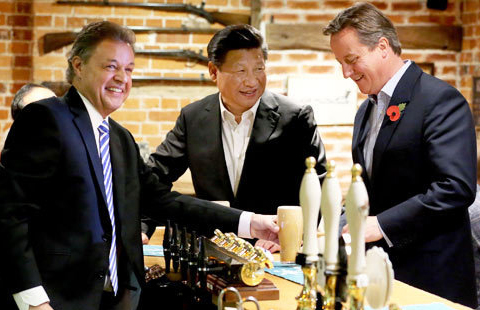 British pub becomes tourist attraction after Xi's visit
European Weekly
 We will not give up search, Li vows
International hunt for missing airliner continues after fruitless six-day search

