


Cameron gets his language right on weibo
By Fu Jing ( China Daily ) Updated: 2013-12-05 08:04:50
 |
|
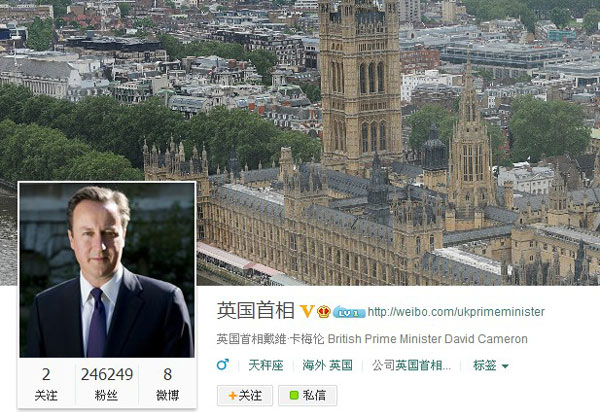
The home page of British Prime Minister David Cameron's Sina Weibo account. He started to use the social networking tool on Friday, and had more than 160,000 followers by Wednseday. [Provided to China Daily] |
When British Prime Minister David Cameron returns home from his carefully choreographed trip to China, he will be surprised by the dozens of business contracts that will start to flow in, as well as by endless questions from thousands of his new Chinese friends on social media.
I have long observed foreign politicians trying to engage with Chinese fans, sometimes in the millions, through social media. Their teams waste no time uploading their schedules, speeches and short ideas in English, French or other languages.
However, these messages usually fail to reach the Chinese public, mainly because they are not written in Chinese.
So I have drawn the impolite conclusion that most efforts by foreign politicians and their handlers to involve ordinary Chinese via social media have been pretty much failures.
But Cameron's team has made a difference. It set up a micro blog for the prime minister on Sina Weibo. Cameron is a latecomer, but for the prime minister it has been a case of better late than never.
By Wednesday, Cameron had uploaded seven posts, even though he only started to use the tool on Friday. Of the seven, three were posted as warm-up messages before he began his China tour.
Cameron has used the Chinese language in all of his posts, and two are bilingual. This marks a huge difference from the posts of other global political figures in the past.
In terms of content, Cameron's posts are all simple and original, and accompanied by photos. They are not mere recaps of official documents, schedules and speeches.
Not shy of advertising, Cameron has even managed to publish two posts about Land Rover in a short time, in an effort to help market the car brand to China's new rich.
The most interesting part of Cameron's excursion into Chinese social media is his team's ambition to set up a dialogue between the prime minister and the public. In one recent post, Cameron asked his followers to leave questions for him, saying he would answer some of them before he left China.
The number of Cameron's micro blog followers surpassed 260,000 in one week, roughly equal to the number of subscribers to two of his country's newspapers, The Guardian and The Financial Times.
Cameron does not have the largest number of followers among the dozens of foreign politicians in China's social media community. European Council President Herman Van Rompuy, who opened a weibo account in 2011, has more than 3 million followers.
Christine Lagarde, managing director of the International Monetary Fund, has been working to expand her network in China and has accumulated more than 3.5 million followers. To my surprise, this Frenchwoman uses French and English most of the time.
Christiana Figueres, climate change chief of the United Nations, also has opened a weibo account that now has more than 45,000 followers, a relatively small number compared to the others. But she and her communications team have almost no experience in using the Chinese language on micro blogs, particularly when discussing this complex topic.
Though Cameron has not responded to the mounting comments on his weibo account so far, he should be delighted by the responses from his followers, who can understand his messages in Chinese. His latest post has been forwarded and commented upon more than 20,000 times.
Van Rompuy had no such luck during his November visit to Beijing. His team published several posts related to his official meetings with Chinese leaders, but each attracted fewer than a dozen comments.
More recently, Van Rompuy made some progress by posting several short notices and comments in Chinese. But the number of responses was still small, given his colossal number of fans.
Van Rompuy welcomed Cameron to blogging in China on Tuesday in his latest post, expressing the wish that the British leader follow suit in making Chinese friends who are truly interested in building closer EU-China relations through social media.
Van Rompuy is correct to encourage European leaders to invest time and energy. But in practice, he and other politicians should follow Cameron's example. While blogging in China is open, fast and interactive in China, it shares features with traditional media content.
The politicians should bear in mind that content is king in social media, just as it is in journalism. It is the key to expanding a social media network and attracting a bigger audience.
Furthermore, using netizens' own language shows respect. It would be useful if foreign political figures followed Cameron and studied his team's efforts to carry on effective conversations with Chinese followers.
I have become a follower of Cameron's. I sent him a question, in both Chinese and English, asking about his plans to maintain a smooth dialogue with the Chinese to avoid the ups and downs of bilateral relations. I am looking forward to his reply.
Contact the writer at fujing@chinadaily.com.cn








European Weekly
 China taken on as building partner
Meetings with central and Eastern European heads underline China's global roal.

