


Mandarin gaining in popularity
By Cecily Liu ( China Daily ) Updated: 2013-12-02 07:26:48|
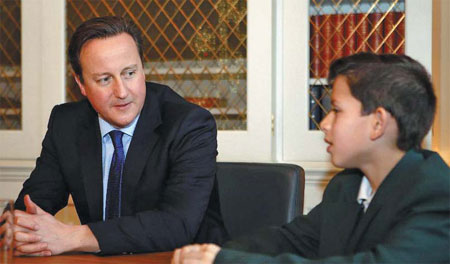
Ahead of his trip to China, British Prime Minister David Cameron meets with a student from Bohunt School who has been learning Mandarin. Cameron will pay an official visit to China from Monday to Wednesday. Wang Lili / Xinhua |
On Saturday morning, while taking a stroll in London's Regent's Park, I was greeted by a sweet, soft voice behind me saying, "Ni hao", which means "hello" in Chinese.
I turned around and was surprised to find that the voice came from a blonde girl, about 10 years old, who stared at me with wide, blue eyes full of curiosity. I greeted her and she told me her name and school in simple Chinese sentences.
Her spoken Chinese was not fluent, but her courage to practice it with a stranger surprised me and drew us closer immediately. Her mother later told me that the little girl had just learned some new Chinese words at school and was keen to practice them.
Perhaps such an encounter is not so surprising, considering that British Prime Minister David Cameron has been encouraging British schoolchildren to learn Chinese ahead of his visit to China.
On a recent visit to schools, Cameron asked the children what message they'd like him to deliver to Premier Li Keqiang and asked them to tell him their messages in Chinese, using words they have learned at school.
The children promptly did so, demonstrating the fruits of a surge in the popularity of Mandarin classes in recent years.

One factor in this surge is the growth of Confucius Institutes in the UK, which are Mandarin-teaching centers built on university campuses. More than 10 Confucius Institutes have been established in the UK so far, each one sending tutors to help teach Mandarin to a handful of neighboring primary and secondary schools.
More and more British schools are incorporating Mandarin into their foreign-language curriculums, alongside traditionally popular languages like French and German.
One example is Wellington College, which invested 500,000 pounds ($818,600) last year to build a pagoda for the purposes of teaching Chinese language and culture. Anthony Seldon, headmaster of the college, became a pupil too.
In November 2010, British Education Secretary Michael Gove announced a pioneering partnership, expected to run over five years, with China to train 1,000 more Mandarin teachers for secondary schools in England.
This surge in interest in Mandarin is largely due to China's rise as a global power and the vast range of career opportunities the country seems to offer to Britain's young students.
Recognition of the importance of the Sino-British business relationship at a government level has also led to favorable policies that encourage students to study Mandarin.
One example is a new plan that the British Council launched over the summer. It aims to encourage 15,000 British students to study or intern in China by 2016, and the project will undoubtedly trigger curiosity among students about China and its language.
The growing popularity of Mandarin is, of course, not limited to the classroom. In today's Britain, phrases like "xie xie" (thank you) and "bu ke qi" (you're welcome) are often said to me by waiters in restaurants, taxi drivers and the postman upon discovering I am Chinese.
Although I think there is a long way to go before I can have a proper conversation with them in my mother tongue, the fact that they are trying to speak to me in Chinese words and phrases make me feel welcome in the UK.
And I also think their fascination with the Chinese culture has made them more aware and tolerant of the cultural differences between us, and with tolerance I can feel more understanding and compassion in their attitude toward me.
Perhaps Cameron's encouraging British students to learn Mandarin will make a big difference to Sino-British political and business relations in the future, as it is only through understanding and compassion that good relationships can be built and maintained.
Contact the writer at cecily.liu@chinadaily.com.cn








European Weekly
 China taken on as building partner
Meetings with central and Eastern European heads underline China's global roal.

