Comments
  Print
Print  Mail
Mail  Large Medium Small
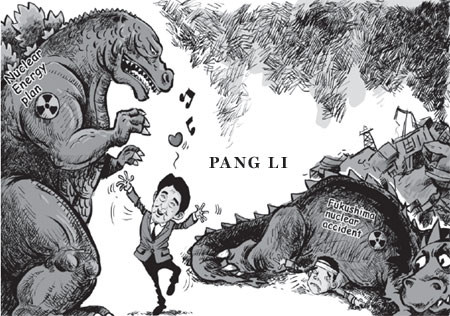 |
Abe's move to modify the interpretation of Japan's constitution is to lay foundation for its use of military force overseas
Removing the restraints on collective self-defense imposed by Japan's pacifist Constitution through constitutional interpretation has become a top priority for Japanese Prime Minister Shinzo Abe and his cabinet, as these restraints are the last "defensive line" of the Japanese pacifist Constitution. If this defensive line is breached, the pacifist Constitution will exist in name only.
To revise the pacifist Constitution and rid Japan of the postwar system have long been the goals pursued by Japan's right-wing forces. Abe has even said that it is the "historic mission" of the Liberal Democratic Party to revise the Constitution, and he has made the task the core objective for his administration.
Shattering the postwar system is closely linked to the issue of Japan's so-called international status. The Japanese right-wing forces claim, first, that the pacifist Constitution was imposed by the United States and the Constitution must be changed as it was not established by Japanese themselves; second, the Constitution imposes restrictions on Japan's military buildup and the use of its forces overseas, preventing Japan from playing a political role in the international arena by virtue of its military forces like other states, so Japan must revise the Constitution so as to become a "normal state"; third, as Japan is forbidden from using force overseas, it cannot become a political power, which does not accord with its economic superpower status. Abe's push for "proactive pacifism" seeks to enable Japan to use military force in dealing with international affairs, and so will remove the restrictions imposed by the current Constitution.
But although the pacifist Constitution has already been seriously eroded, changing its wording still faces huge resistance from the Japanese people. Therefore, Abe is attempting to modify the interpretation of the Constitution to remove the constraints on the right of collective self-defense so as to enable Japan to use force overseas.
Abe's zeal on constitutional revision and collective self-defense contains the deeper questions of what road Japan is taking and in what direction? Next year will be the 70th anniversary of the end of World War II. Under the auspices of the pacifist Constitution, Japan has followed a road of peaceful development, paying more attention to its economy than its military might.
But Abe wants to lead Japan down a different road. To this end, he has not only visited the Yakusuni Shrine as the backbone of Japan's "together we visit the Yasukuni Shrine lawmakers alliance", he has also questioned the Tokyo war crimes trials, defended the system of "comfort women", sped up the revision of textbooks to deny historical truths and is trying to replace the Murayama Statement, which expresses deep remorse for Japan's colonial rule and aggression. Now he seeks to change Japan institutionally to promote the construction of a military system that can use force abroad.
During his first stint as prime minister, Abe upgraded Japan's Defense Agency to a Ministry of Defense, laying the institutional foundation for turning the country's Self-Defense Forces into a full-fledged military. Japan's military management system and operational command system have now basically completed the transition to a military and the attack capabilities of the SDF have been greatly improved, in particular its motorized combat capability for foreign operations.
Meanwhile, in order to strengthen the administrative power of the prime minister, Japan established its own version of the US National Security Council, and, disregarding fierce public opposition, Abe and his LDP-led coalition pushed through tough legislation to protect state secrets. In this way, the Abe cabinet has formed a new system to strengthen executive power and weaken public supervision in a bid to speed up Japan's overall transformation.
Abe's comprehensive transformation of Japan exhibits the trend of political centralization, but even more dangerous it is preparation for constitutional revision and military buildup. Abe is determined to confront China. So as to strengthen the military and release the Self-Defense Forces from their constraints, he is trying to create the illusion of a "China threat" and seeking to present Japan as the "victim" of China changing the status quo. In doing so, he has made Japan the root of instability in Northeast Asia.
The author is an associate researcher with the China Institute of international Studies.

 Chinese lose sleep as they aim to achieve goals
 Balancing an egg on end during vernal equinox
 Children receive treatment after eating rat poison
 Men can be good pole dancers
 Farmer builds own drones to spray crops
 Tank flattens phony fire fighting gear
 No common health ills for kids given drugs
 Sand storm hits Xinjiang
Copyright 1995 - . All rights reserved. The content (including but not limited to text, photo, multimedia information, etc) published in this site belongs to China Daily Information Co (CDIC). Without written authorization from CDIC, such content shall not be republished or used in any form. Note: Browsers with 1024*768 or higher resolution are suggested for this site.
License for publishing multimedia online 0108263 Registration Number: 20100000002731