Breakthrough ink discovery could transform printing


 |
|
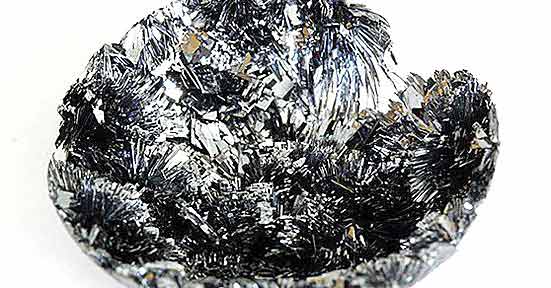
Black phosphorus in its crystal form. [Photo/China Daily] |
Scientists from UK and Chinese universities have developed a new ink that could improve the performance of devices in the cutting-edge field of printed electronics.
Researchers from the Hybrid Nanomaterials Engineering Group at Cambridge University's Graphene Center successfully incorporated black phosphorus, a two-dimensional material similar to graphene, into ink that is compatible with conventional inkjet printers.
The team collaborated with scientists at the Chinese Academy of Sciences and Beihang and Zhejiang universities.
Graphene and black phosphorus are part of a growing family of revolutionary two-dimensional materials that are subject to intense scientific research due to their special properties.
Black phosphorus is not as conductive as graphene, though it is sensitive to a greater region of the electromagnetic spectrum including infrared, making it ideal for the development of optoelectronic devices.
Such devices that detect, source or control light include solar cells, light emitters, optical fibers, and sensors. The material may also have applications in technologies such as flexible, wearable electronics.
Hu Guohua, a PhD student at Cambridge University and lead author on the study-which has been published in the science journal Nature-said the team printed the new ink onto a range of materials.
"Printing on silicon means it can be used to make transistors or photodetectors," he told China Daily. "If we print on plastic, it can be used to make flexible devices and on glass for transparent devices."
The Chinese's interest in British research into the commercial application of two dimensional materials was highlighted by President Xi Jinping's visit to the National Graphene Institute in Manchester during his 2015 State visit to the UK.
The beneficial properties of black phosphorus have been known for some time, but until now there was no reliable way to convert the bulk crystals into a stable and printable ink.
"We think we can integrate printed black phosphorus onto existing silicon-based technologies like circuits, sensors, and interactive devices like wearable electronics," Hu said.
The team at Cambridge used a solution processing technique in order to break the bulk crystals into ultrathin nanomaterials, only a few atomic layers across.
In 2015, the same researchers developed a high-speed method for printed electronics using graphene, which was also led by Hu.