Stronger US-South Korea alliance should not rock Northeast Asia stability


 |
|
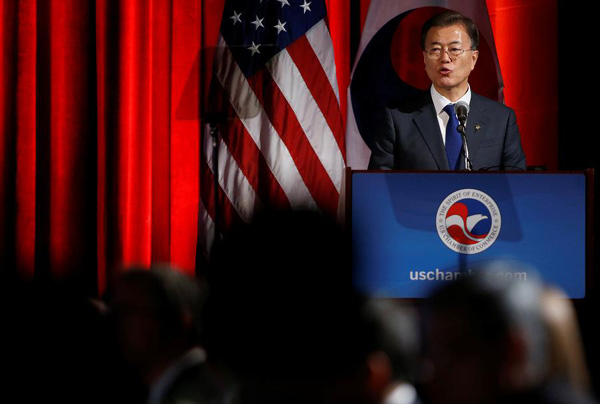
South Korean President Moon Jae-In speaks to the US Chamber of Commerce in Washington, US, June 28, 2017. [Photo/Agencies] |
BEIJING - South Korea's newly elected President Moon Jae-in departed for Washington Wednesday for his first meeting with US President Donald Trump, making Seoul's traditional ally his first foreign destination since taking office in early May.
The visit, which marked Moon's first meeting with a foreign leader as president, demonstrated Moon's determination to shore up US-South Korean military alliance, but under no circumstances should that come at the cost of tilting regional balance or disrupting stability in Northeast Asia.
Moon has made it clear in earlier interviews ahead of his trip that Seoul and Washington share the common goal of denuclearizing the Korean Peninsula, establishing a peace regime on the peninsula, and building peace and security in Northeast Asia.
Safeguarding regional peace and stability and realizing a denuclearized Korean Peninsula require all parties concerned to do their due part, step up communication and collaborate to remove misgivings and mistrust, rather than pursue a quick fix that might cause catastrophic consequences and jeopardize regional security in the long run.
Moon, a liberal as opposed to his two predecessors that had ruled South Korea for 10 years, conceded in an interview with "CBS This Morning" that the Korean Peninsula's nuclear issue cannot be resolved through only sanctions and pressure.
To freeze and dismantle Pyongyang's nuclear arsenal, Moon has proposed a dual-track approach of pressuring Pyongyang to cease nuclear programs while seeking engagement with it, which showed greater flexibility in dealing with its the Democratic People's Republic of Korea (DPRK).
Meantime, in a gesture of good will, DPRK's ambassador to India Kye Chun Yong reiterated an offer to negotiate a nuclear test moratorium in exchange for a halt to the annual military exercises jointly staged by the United States and South Korea, a proposal flatly rejected by Washington in January 2015.
The large-scale war games, which Seoul claimed to protect South Korea from the DPRK's missile and nuclear threat, are considered by Pyongyang as a rehearsal for preemptive attacks.
Pyongyang has repeatedly hinted that negotiations and dialogue would be possible on conditions that the US administration abandons its deep-seated hostilities against the DPRK.
The Trump-Moon summit comes at such a critical moment where whether the Trump administration has the decisiveness to translate its promise of not seeking Pyongyang's subversion into a good-faith response may change the course of denuclearization on the peninsula, as well as peace and stability in the region at large.
While the two allies are expected to highlight "the special meaning of the South Korea-US alliance" and strengthen their military bond, it is important to refrain from using military threats that would exacerbate the situation and rethink the controversial deployment of the Terminal High Altitude Area Defense (THAAD), an anti-missile shield that severely harms national security of neighboring countries including China and Russia.
Moon has slowed down the delivery and installment of the rest of the four launchers and urged an environmental impact assessment before proceeding with the final deployment, after it turned out the South Korean military had hidden the arrival of the launchers from his office. But the president denied going through due procedures means a reversal in the THAAD decision.
The THAAD, which comprises an X-band radar that enables the United States to snoop on half of China's territory and the southern part of Russia's Far East, breaks regional strategic balance and runs counter to the endeavor to achieve denuclearization on the peninsula as it merely adds complexity to the situation all the more.
Since all eyes will be on the upcoming summit between the two leaders that will possibly work together for the next five years, it is desirable that both countries take a long vision to navigate through the quagmire and encourage positive effort toward the ultimate goal of denuclearizing the Korean Peninsula and maintaining regional peace and prosperity.