Volunteers break barriers


|
Yin Binbin with children in Mathare, a poverty-stricken area in Nairobi, the capital of Kenya. Photo Provided to China Daily |
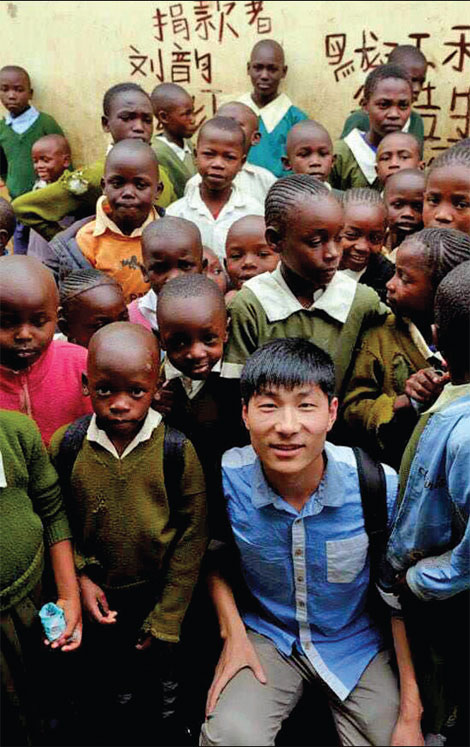
The association now has five full-time employees in Kenya, and about 70 volunteers arrive from China to help each year. An additional 69 contribute via the internet, according to Yin.
Other young Chinese have also rolled up their sleeves to help people in Kenya. Yuan Xiaoyi, a 21-year-old student at New York University, and three other female Chinese students founded an NGO, Care for All Kids, after Yuan volunteered to work in the country in 2013. The organization provides low-cost training for teachers from "informal", or unofficial, schools. Last year, the NGO organized training for teachers at more than 120 schools in Kenya.
Meanwhile, Zhang Chi, 22, an architecture student at Yale University, collaborated with refugees to set up a school when she volunteered to work in Kakuma, the largest refugee camp in Kenya.
"We want to inspire more people through the work we do. Many young people in China are eager to engage in international development - they just need a channel to begin," she says.
Expanding exchanges
Despite the efforts of young Chinese to connect with people in Africa, there is still not enough contact between the groups, according to experts.
Janet Eom, research manager of the China Africa Research Initiative at Johns Hopkins University in the United States, says the Chinese public has not yet caught up with the country's growing economic engagement in Africa, even though Confucius Institutes teach Mandarin and Chinese culture and volunteers help with health programs. For example, Chinese medical teams worked on the Ebola crisis, and training programs for local workers are emerging via Chinese agricultural and manufacturing projects across Africa.
"I think that in contrast to Chinese companies and investors, the general public in China is less aware of opportunities in Africa," Eom says.
Isaac Kwaku, chairman of the Sino-Africa Centre of Excellence Foundation in Kenya, says: "To our knowledge, there is not yet a significant presence of regular Chinese citizens on the ground in Africa. However, some organizations are doing an excellent job of expanding exchanges."
He says the center has worked with AIESEC, one of the world's leading nonprofit, student-run organizations, and with student associations at Peking University and the University of Hong Kong to bring students to Africa as interns.
"Based on the number of internship applications we receive every year, the number of Chinese students going to Africa as interns or volunteers is definitely rising," he says. "There has been a change in the interests of Chinese youth. Originally, the projects that brought young people to Africa were wildlife conservation or volunteer programs in informal settlements. Then, an increasing number of students became interested in researching different topics in Africa, and then in internships," he says.
According to Kwaku, there are still some obstacles to the promotion of mutual exchanges between Africa and China. One of them is "the lack of understanding of Africa as a continent, more than poverty, disease and wildlife. When young people come only for 'poverty tourism', they will never fully understand the dynamics and potential of the development of Africa and China-Africa ties."
Some Chinese NGOs have tried their hand at programs in Africa as well.
In June, when Zction, an NGO that mainly involves college students in China, tried to organize its first African volunteer program, the move attracted great attention. "Quite a lot of people signed up for it," says Lin Qianru, head of the organization's Shanghai branch.
The NGO arranged interviews and chose the 32 best-qualified candidates, but only six made the trip to Uganda, where they had volunteered to teach in a school. "Most quit because of parental opposition prompted by safety concerns," says Lin, a student at Shanghai International Studies University, who also met opposition to her trip.
"Although my parents, uncles and aunts were concerned for my safety, they showed support. I experienced more opposition from people of my grandfather's generation," she says, adding that seniors have an entirely different impression of Africa than younger people do.
"The village we stayed in is safe and the villagers are honest. We will have more programs in Africa soon," she says.
Guo Xiaojun contributed to this story.
houliqiang@chinadaily.com.cn