UK faces tougher Brexit challenge after 2017 resilience - Hammond


LONDON - Britain's economy is likely to feel the impact of the Brexit vote in the coming years after an initial period of resilience, finance minister Philip Hammond said as he spelt out his plans to steer the economy through its departure from the European Union.
|
 |
|
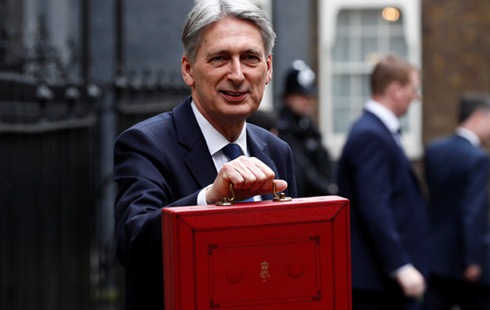
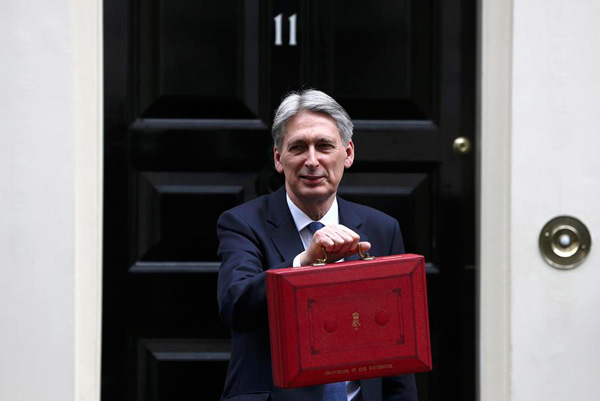
Britain's Chancellor of the Exchequer Philip Hammond stands outside 11 Downing Street before delivering his budget to the House of Commons in London, Britain March 8, 2017.???[Photo/Agencies] |
With Britain poised to kick off the process of leaving the bloc, Hammond said the economy had so far "continued to confound the commentators" by withstanding the referendum shock, setting it up well for the Brexit talks ahead.
The economy is now on course to grow by 2.0 percent in 2017, up sharply from a forecast of 1.4 percent made in the latest round of official forecasts in November, according to the Office for Budget Responsibility (OBR).
But growth from next year to the end of the decade is set to be weaker than thought as the OBR cut its forecasts for 2018, 2019 and 2020 from November's outlook.
Hammond said he would not be distracted from his plan to bring down what remains one of the biggest budget deficits among the world's rich nations, something he is aiming to eliminate at some point in the first half of the next decade.
"The only responsible course of action ... is to continue with our plan, undeterred by any short-term fluctuations," he said in parliament. "We will not saddle our children with ever-increasing debts."
Hammond, who joked that had to defend his nickname 'Spreadsheet Phil', has eschewed budget gimmicks and instead wants to build a reserve fund in case he needs to help Britain's economy through a Brexit slowdown ahead.
He announced a 2 billion pound increase in funding for social care over the next three years, trying to address one of the most high-profile strains on public services at a time of persistent spending cuts.
But all new spending commitments over the next five years were funded by his budget plan, he said, meaning no extra borrowing to pay for them.
To address the challenge of properly taxing the growing number of workers who are self-employed, Hammond said they would pay a higher rate of national insurance contributions. He also made it harder for directors and owners of small firms to take money out tax-free as dividends.
SLOWER BORROWING, HELPED BY 2017 WINDFALL
The Brexit vote in June, which will separate Britain from the EU which buys about half of its exports, had been expected to deliver an immediate and heavy below to the economy.
Instead, consumers continued to spend heavily and helped gross domestic product to grow by 1.8 percent, faster than all other Group of Seven economies in 2016 bar Germany.
Signs are now emerging that shoppers have turned more cautious as inflation rises, pushed up by the tumble in the value of the pound following the referendum.
British Prime Minister Theresa May's plan to launch Britain's EU divorce talks before the end of March could make some companies wary about long-term investments.
But for this year, the news in Hammond's budget was upbeat.
Stronger-than-expected economic growth since June means Britain's budget deficit is likely to fall much faster than previously thought in the current financial year to just under 52 billion pounds or 2.6 percent of GDP.
The OBR now expects the government will need to borrow 23.5 billion pounds less from 2016/17 to the 2020/21 financial year than it projected in November.
But most of that was due to the sharp improvement in the 12 months to the end of March this year, underscoring the challenge further ahead.
Britain's public finances are expected to be in the red by the 2021/22 financial year, the last in the OBR's forecasts.
That represents a slower pace of deficit reduction than Hammond's predecessor George Osborne planned a year ago, when he hoped to return the public finances to surplus by 2019/20.
AP