Trump takes US out of TPP


 |
|
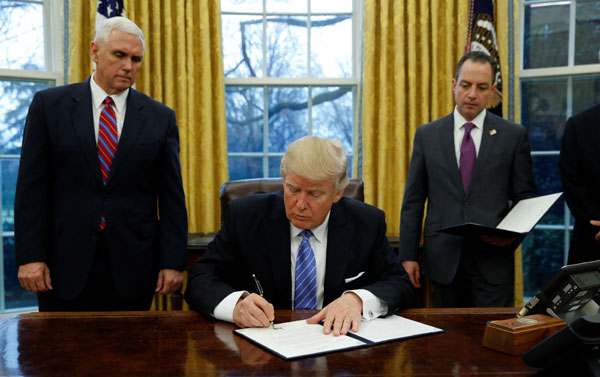
US President Donald Trump signs an executive order on US withdrawal from the Trans Pacific Partnership while flanked by Vice President Mike Pence (L) and White House Chief of Staff Reince Priebus (R) in the Oval Office of the White House in Washington January 23, 2017. [Photo/Agencies] |
Gary Clyde Hufbauer, senior fellow at the Peterson Institute for International Economics, described Trump's executive order to withdraw from TPP as "more symbol than anything new".
"Because the TPP was never submitted to Congress, so (it) was not going to go anyplace anyway. But it was a strong symbol," said Hufbauer, deputy assistant secretary for international trade and investment policy at the US Treasury (1977-79).
TPP was an important component of the Rebalance to Asia strategy pursued by the Obama administration to curtail China's growing influence in the region, where China is the largest trade partner for most nations. Obama had consistently used the geopolitical argument to sell the controversial TPP, saying repeatedly in national speeches that "the United States, not countries like China, should write" trade rules.
On Jan 13, just a week before leaving office, Michael Froman, US trade representative under Obama, described TPP as "not to contain China".
But he quickly said withdrawing from TPP would be a huge gift to China in terms of damaging the US role in the region.
"And I can't understand why any president or administration would want to hand the keys of the castle over to China to say it's better that China set the rules for this region rather than the United States. I think that would have very damaging consequences."
Many US economists, such as Derek Scissors, a resident scholar at the American Enterprise Institute, believe the economic benefits of TPP to the US are quite limited.
China is not a party to the 12-economy TPP agreement. Most Chinese at first regarded TPP as part of a US containment strategy against China. But the Chinese government later expressed its interest to understand more of the agreement.
China has been pushing the Regional Comprehensive Economic Partnership (RCEP), a free trade deal between 10 ASEAN nations and six other countries, including China. The US is not a participant in RCEP negotiations.
He Yafei, a former vice-foreign minister, earlier described TPP as "both a challenge and opportunity for China, as it comes at a critical moment when China tries to engage more deeply and widely in global governance".
"The potential short-term impact of the TPP on China's trade and economy as a whole is almost negligible, while the medium- and long-term impact depends on how China reacts to the TPP and handles its economic 'new normal.' The TPP could even provide impetus for China's efforts to deepen its economic reforms," He wrote on the China-US Focus website.
- Trump signs executive order to withdraw US from TPP
- New Zealand PM open to China involvement in TPP alternative
- Trump turns to talks after bad weekend
- Trump summons business leaders, lawmakers to White House
- White House vows to fight media 'tooth and nail' over Trump attacks
- Trump to staff: devote ourselves to national good
- Donald Trump's first weekend as US president