UNEP: Progress made in air pollution control, but more needs to be done


 |
|
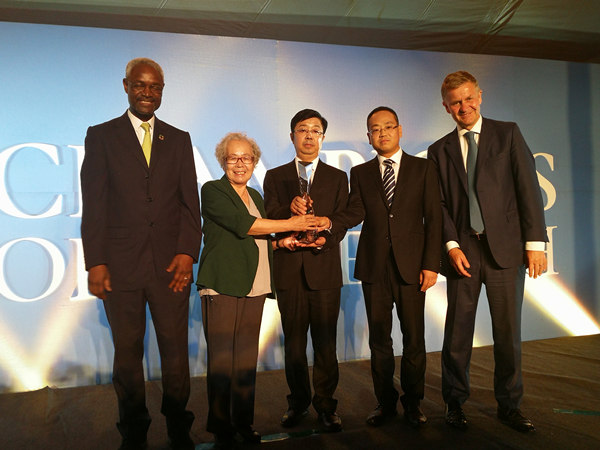
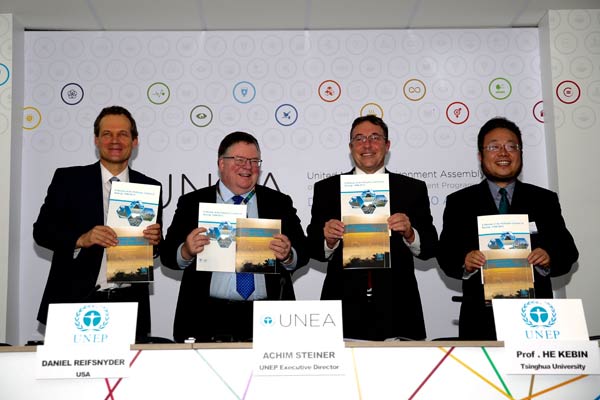
UNEP Executive Director Achim Steiner (second, left) poses for a photo while holding two reports published on Tuesday at a news conferrence with three other environmental experts. [Photo by Hou Liqiang/chinadaily.com.cn] |
The world has seen progress in air pollution control with investment in renewable energy and cleaner indoor burning fuels, but more effort still should be made in reducing emissions to reduce the number of people air pollution kills, said a report.
Actions on Air Quality, released on Tuesday at the second United Nations Environment Assembly by the United Nations Environment Program found improvements in areas such as access to cleaner cooking fuels and stoves, renewables, fuel sulphur content and public transport.
According to the report, 97 countries have increased the percentage of households that have access to cleaner burning fuels to more than 85 percent. This a key move to tackle indoor air pollution, which claims 4.3 million of the total 7 million that are killed by air pollution each year, said the report.
It said more than 82 countries out of 194 analyzed have incentives to promote investment in renewable energy production, cleaner production, energy efficiency and pollution control equipment. Renewables accounted for a majority of the new electricity-generating capacity added around the world for the first time last year at an investment of $286 billion, according to research by UNEP, Bloomberg and the Frankfurt School.
Another report released on Tuesday, which looks at attempts to control Beijing's air pollution over a 15-year period, also finds steady improvements are being made. A Review of Air Pollution Control in Beijing: 1998-2013 analyzed measures implemented since Beijing began launching its air pollution control program, which saw a steady downward trend in the concentrations of many harmful pollutants.
The Beijing analysis, carried out by UNEP and the Beijing Municipal Environmental Protection Bureau, found that carbon monoxide and sulphur levels are now below limits set by China's National Ambient Air Quality Standards, while nitrogen dioxide and particulate matter ten levels are also creeping closer to the standards.
This trend has been driven by a decrease in coal consumption in the power sector and a drop in vehicle emissions resulting from vehicle emission control measures. Coal use fell from a peak of 9 million metric tons in 2005 to 6.44 million tons in 2013, while the 2013 levels of carbon monoxide dropped by 76 per cent compared to 1998.
When it comes to emissions control, however, it's not impressive with only 29 per cent of countries having adopted Euro 4 emissions standards or above and less than 20 per cent of countries regulating open waste burning. The report said policies and standards on clean fuels and vehicles could reduce emissions by 90 per cent.
According to the World Health Organization, global urban air pollution levels increased by 8 per cent between 2008 and 2013. More than 80 percent of people living in urban areas that monitor air pollution are exposed to air quality levels that exceed WHO limits, threatening lives, productivity and economies.
UNEP Executive Director Achim Steiner said, "A healthy environment is essential to healthy people and our aspirations for a better world under the 2030 Agenda for Sustainable Development.
"We are indeed making progress on air pollution, but the fact remains that many people are still breathing air outside of World Health Organization standards. The health, social and economic costs are massive and rising."
UNEA is the world's most powerful decision-making body on the environment, and responsible for tackling some of the most critical issues of our time.
Attracting hundreds of key decision makers, businesses and representatives of intergovernmental organizations and civil society this year, UNEA-2 is one of the first major meetings since the adoption of the 2030 Agenda for Sustainable Development and the Paris Climate Agreement.
Contact the writer at Kenya houliqiang@chinadaily.com.cn.