Major powers working as equals could help organization realize global security goal
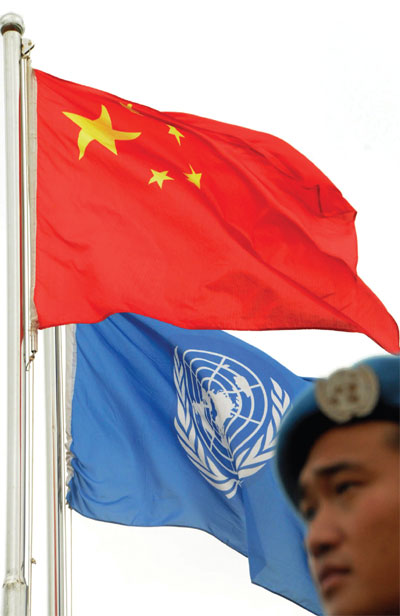
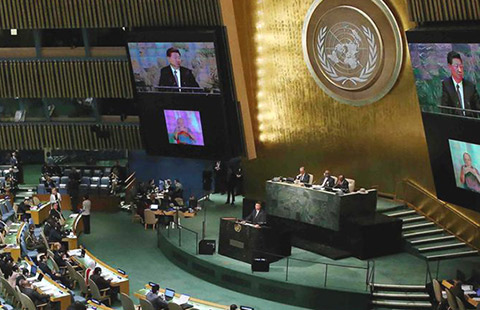
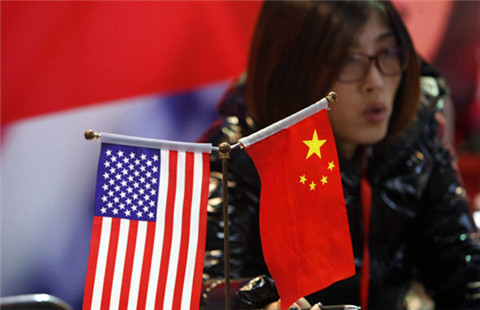
A new model of major country relationship between China and the United States, characterized by mutually beneficial cooperation, is conducive to the cause of the United Nations, experts have said.
"In some respects, the new model would return the UN to the original vision of its founders," said Ted Carpenter, a senior fellow of defense and foreign policy studies at Cato Institute, a Washington think tank.
When it was founded 70 years ago, immediately after World War II, the intergovernmental organization was designed to prevent another such conflict. It has since played a key role in maintaining peace, fostering development, and promoting human rights.
"Especially with regard to security issues, the architects of the UN assumed that the major powers would cooperate closely," Mr. Carpenter said, but Cold War tensions prevented that vision from ever becoming reality.
For a moment after the end of the Cold War, it looked as though such cooperation might be possible, he said. The US insistence on maintaining its global dominance stifled that opportunity, but "now, once again, the vision of cooperation among major powers of roughly equal status has the potential to be realized."
For that to happen, he said the US needs to relinquish its desire for global hegemony and treat other major powers, especially rising non-Western powers like China and India, as equals. It also means recognizing that major powers have special responsibilities, and the greatest interests at stake, in their respective geographic regions.
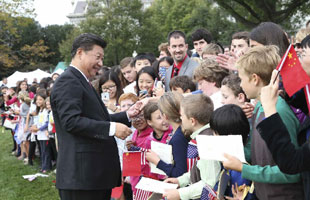
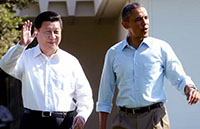
At their Sunnylands summit in 2013, presidents Xi Jinping and Barack Obama endorsed the idea of building a new model of major country relations based on nonconfrontation, nonconflict, mutual respect, and win-win cooperation, aiming to avoid the zero-sum games that have historically been seen between rising powers and established ones.
The emerging model has already yielded what Chinese State Councilor Yang Jiechi called "a real early harvest," including surging bilateral trade, as well as coordination in addressing pressing issues such as climate change and the Korean Peninsula.
Jia Lieying, director of Beijing Language and Culture University's UN Research Center, said that greater consensus between leaders of the two countries, both with veto privilege, will exert a positive influence on the UN's operation and development.
"It's up to the leaders of the two nations to enhance mutual trust and furnish the new model with more substance and specifics," he said. For example, the annual China-U.S. strategic and economic dialogue could be tuned to help translate the new model into doable policies and projects.
Zhiqun Zhu, a professor of political science and international relations at Bucknell University Lewisburg, Pennsylvania, said the two global powers and permanent members of the UN Security Council must coordinate their policies and approaches on major issues such as climate change and nonproliferation of nuclear weapons.
The academic, who is also head of the university's China Institute, said he has observed that, in recent years, Beijing has aligned its position on many international issues with that of Washington and Brussels.
As China's power rises and influence in the UN grows, he said the country may not always agree with other permanent members of the Security Council, but it will continue to be a powerful voice speaking for the developing world.
In fact, experts agree that China, as the world's largest developing nation, has enhanced influence due to its close ties to a variety of developing countries as well as Russia.
"Thus, China has an especially crucial role to play as a diplomatic bridge between the west (and Russia) and the developing countries of Asia, Africa, and Latin America," Mr Carpenter said.
Peter van Tuijl, executive director of Global Partnership for the Prevention of Armed Conflict Global Secretariat in The Hague, said most of the crises in the world today require greater international collaboration, such as climate change, the increasing number of refugees, transnational crime and violent extremism, and armed conflicts in a number of fragile states and regions.
"To address these issues is of great importance for China, whose progress over the past decades is a testimony of how development and peace reinforce each other," he said.
Acknowledging China's contributions to UN peacekeeping operations and mediation efforts, Luk Van Langenhove, director of the UN University Institute on Comparative Regional Integration Studies, in Belgium, said he believed China's contribution in climate change would be "crucial."
As one of the largest economies in the world, China can indeed show the way and be at the forefront of transforming its economy toward renewable and cleaner energy driven, he said in an e-mail.
"Here, one can only hope that the current slowdown in the Chinese economy will not defer the major steps already taken," he added.
Fu Jing in Brussels contributed to this story.
|
Xiao Yong / Xinhua |
(China Daily USA 09/27/2015 page4)
Copyright 1995 - . All rights reserved. The content (including but not limited to text, photo, multimedia information, etc) published in this site belongs to China Daily Information Co (CDIC). Without written authorization from CDIC, such content shall not be republished or used in any form. Note: Browsers with 1024*768 or higher resolution are suggested for this site.
License for publishing multimedia online 0108263 Registration Number: 130349