 |
|
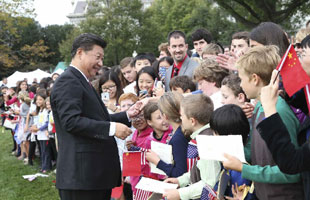
Screen capture of the video titled Who is Xi Dada |
What would people say if an American reporter rounds up a dozen international students on a US college campus and queries them on their impressions of the US president in the lead-up to his state visit to China? And what if they are to give their answers in Chinese?
First, they'd probably say something nice. Second, their linguistic limitation would lead to the misuse of some words since they are not using their native language.?
That's exactly what happened?- except that the scenario is reversed as it's the Chinese president on a state visit to the US?- to a video titled Who is Xi Dada, released by People's Daily both in and outside China. Unlike the impression of an American blogger, I did not find much resemblance of the students in the video to "Justin Bieber fans gushing about their pop idol."
To my eyes, they appeared polite and slightly diplomatic. Some of the words of idolatry come across more as feeble attempts at humor or enthusiasm. American informercials have more convincing actors masquerading as ordinary consumers.
But the same word or smile can take on very different meanings in different cultural contexts. Dada, by the way, does not mean daddy. It refers to uncle — or more precisely the father's elder brother?- in some Chinese dialects and was given to President Xi Jinping by Chinese netizens long before a September 2014 meeting he had with a group of college teachers, during which he was asked whether it was okay to address him as Xi Dada and he gave his consent.
This connotation of "avuncular" also applies to the Chinese term "dage", which is verbatim for "big brother" and unfortunately translated as such without any regard to the totally different connotation in English. The George Orwell meaning of "big brother" is completely unknown in China even though the book has long been available in Chinese translation.
Bilingual trickery wrecks havoc with more common terms. A phrase like "Come on", used frequently in the video's subtitle, is essentially untranslatable because its meaning changes with the context. The same goes for "jia you", literally "adding gasoline". People with just a little knowledge of a foreign language tend to rely on dictionaries and come up with ludicrous translations when such terms of ambiguity and multiple definitions are involved. What the foreign students were saying in the video is the equivalent of "Great!" "Good for him!" "Keep up the good work!"?- general words of support but, in English, they sound awkward at best.
In the echelon of "propaganda video", to borrow the American blogger's word?- a word Chinese officials until very recently had insisted on using because the dictionary stipulates "xuanchuan" be translated as "propaganda"?- this video is actually a little step forward in the skill of communication. (Now, "communication" is the in-vogue word for such purposes.) Instead of having wordsmiths inventing glowing words, someone actually went out and talked to ordinary students. Whether you like it or not, what they had to say is pretty much what I've heard in China all along, and far from the hyperbole that one hears during a US election event.
Related Stories
Copyright 1995 - . All rights reserved. The content (including but not limited to text, photo, multimedia information, etc) published in this site belongs to China Daily Information Co (CDIC). Without written authorization from CDIC, such content shall not be republished or used in any form. Note: Browsers with 1024*768 or higher resolution are suggested for this site.
License for publishing multimedia online 0108263 Registration Number: 130349