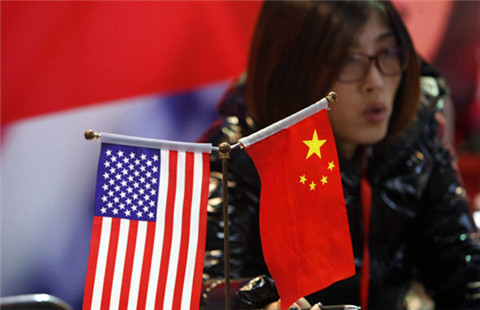
The United States was called a "melting pot" back when I was studying American pop culture in college 10 years ago. The exact meaning of the melting pot not only lies in the multi-ethnic population but a cauldron of perceptions and judgments. During this trip also I have heard diverse opinions in Washington on China, especially related to its economic growth.
To many Chinese who have never been to the United States, the stereotypical impression of the US may be that Americans have an adverse opinion on China's fast economic growth. They may take it for granted that the US takes China's booming exports as a way of steeling jobs from US citizens and a threat to its overwhelming power on the planet. But I witnessed something different.
Before President Xi Jinping began his state visit to the US, many institutions in Washington held events focused on China. Through these events, I discovered that some US individuals and institutions have different perception of China after they carefully studied China.
Washington has many politicians who lobby and raise funds for some causes while dozens of think tanks are either headquartered or have a branch in the capital.
According to the Pennsylvania Library, the United States has 11 of top 30 think tanks around the world, including the Brookings Institution, the Carnegie Endowment for International Peace and the Center for Strategic and International Studies that are all based in Washington.
Freedom of speech is a fundamental rule in the US and Chinese constitutions and therefore different groups may express different opinions. Although I have a double bachelor degree in international relations with focus on American politics, like many international relations majors, I thought almost all institutions shared a similar stance toward China. In Washington, I was proved wrong.
After carrying out careful research, think tanks come to their own judgments about the second-largest economy On Sept 15, I attended a lecture at the Center for Strategic and International Studies (CSIS), one of top think tanks globally. Rhodium Group, a research institute based in New York that has been often cited by Chinese media, released a report gauging Chinese gross domestic product. The report, completed in two years, reached a conclusion that China is bigger, not smaller in terms of GDP.
Daniel Rosen, partner of Rhodium, and his colleague Bao Beibei spent two years to adjust China's GDP with a focus on the fund spent on research and development activities. Rosen said China's GDP should be 13 to 16 percent more than what the National Bureau of Statistics of China had announced since 2008.
During the past three decades, China's economy has posted double-digit growth annually. Many scholars in the west questioned the fast speed. Was it created by Chinese authorities to boost confidence? That was a question I was often asked as a Chinese journalist. I also often heard western media and researchers complain that the National Bureau of Statistics exaggerated the numbers for years.
"There was no need to exaggerate the national records as the Chinese economy was already huge," said Rosen. Now a US institute has the answer, which should be more convincing in the west. I was also shocked to hear such a conclusion.
Related Stories
Copyright 1995 - . All rights reserved. The content (including but not limited to text, photo, multimedia information, etc) published in this site belongs to China Daily Information Co (CDIC). Without written authorization from CDIC, such content shall not be republished or used in any form. Note: Browsers with 1024*768 or higher resolution are suggested for this site.
License for publishing multimedia online 0108263 Registration Number: 130349