 |
 |
 |
|
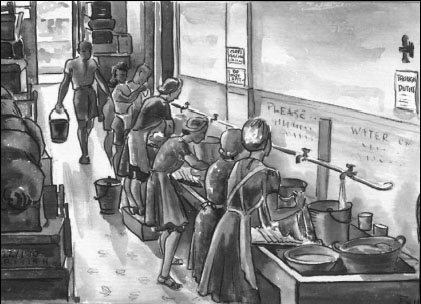
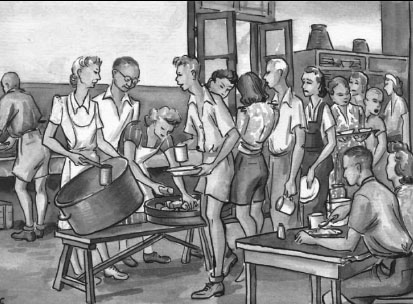
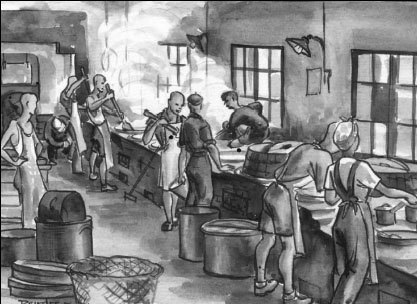
Paintings by Deirdre Fee from Ireland, a friend of Betty Barr's mother, depicting life in the internment camps in Shanghai. PHOTOS PROVIDED BY THE MEMORIAL SITE OF THE 4TH NATIONAL CONGRESS OF THE COMMUNIST PARTY OF CHINA |
From January 1943 to August 1945, more than 6,000 expatriates from Japan's enemy states, including the US, UK, the Netherlands, Canada and Australia, were taken into custody in nine internment camps across the city, said Xiong Yuezhi, deputy president of Shanghai Academy of Social Sciences.
Based on Xiong's study, foreigners from other internment camps suffered a worse fate. In 1945, the year the war ended, the Japanese had moved detainees in a camp in western Shanghai to military facilities, using them as human shields against American bombings. Foreigners who were deemed hostile to the Japanese during the war were moved to the Bridge House.
"I have a friend now in Scotland whose father was in Bridge House. He said his father never spoke about it afterwards. I suppose it was something too terrible," said Barr.
The happiest moment for most people in the Longhua camp was the day American planes formed a smoke trail resembling the letter "V" (for victory) in the sky. Everyone was excited because they knew the Allies had won the war in Europe. Barr recalled that between May and August 15, 1945, more and more American planes were bombing Japanese positions in Shanghai.
"They flew very low over the camp. We could see the pilots. And they knew where we were," Barr said. The planes also dropped parcels containing provisions and this made her mother very proud, because she was one of the few Americans in Longhua.
The camp was liberated by the Swiss on August 15, 1945 when Emperor Hirohito announced via radio broadcast that Japan was surrendering. However, it was not until November that all the people in internment camps were evacuated, said Xiong. Barr and her mother went to the US, but returned to Shanghai half a year later.
As part of the commemoration efforts of the 70th anniversary of end of this war, artifacts from these internment camps in Shanghai are now being exhibited at the Memorial Site of the 4th National Congress of the Communist Party of China. Fee's illustrations of wartime life in the camp can also be found in this exhibition which will run from August 14 to December 31.
To Barr, the most meaningful artifact on display is the letter which she sent to her grandmother from the camp.
"It symbolizes the contact with my mother's family in America," said Barr.
Despite having gone through those trying times, Barr does not bear any resentment toward the Japanese.
"That was part of the war," she said. "What I do know is that it's very important to know this part of history and to be careful to ensure that another war doesn't happen."
Copyright 1995 - . All rights reserved. The content (including but not limited to text, photo, multimedia information, etc) published in this site belongs to China Daily Information Co (CDIC). Without written authorization from CDIC, such content shall not be republished or used in any form. Note: Browsers with 1024*768 or higher resolution are suggested for this site.
License for publishing multimedia online 0108263 Registration Number: 130349