 |
|
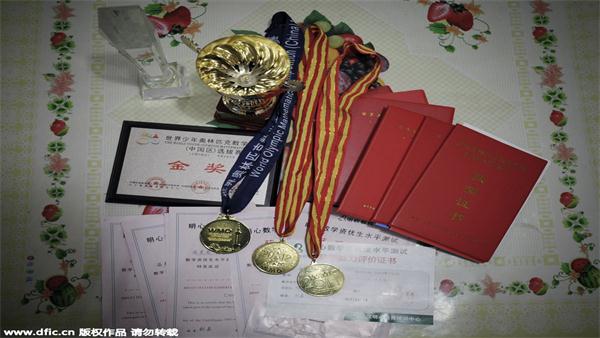
A Chinese student shows his acquired awards in the Mathematical Olympiad competition. [Photo/IC] |
The defeat of Chinese students at the hands of their US counterparts at this year's International Mathematical Olympiad has sparked a public discussion. But this is not the first time that China has lost in the IMO - this is China's sixth loss in the 25 years it has been participating in the contest.
The loss has prompted some to say the authorities should pay greater attention to Olympiad math by, for instance, restoring its original status. But there is confusion here. What the education authorities can manage is "nationwide Olympiad math training" in elementary schools, which is totally different from the IMO, a top international math contest for high school students.
Many math experts agree that rigorous Olympiad math training in elementary schools has nothing to do with cultivating mathematical thinking. Instead, it can spoil students' interest in the subject. And, with the education authorities making progress toward a balanced compulsory education system, the nationwide fever for Olympiad math is subsiding.
Good math knowledge in the US is polarized. In China, on the other hand, not only many shopkeepers and street vendors are good at mental math, but also the math scores Chinese students achieved in the Program for International Student Assessment are much higher than their American peers. Despite this, however, the number of top-notch Chinese math talents with international recognition is pitifully small, and this is what economist and Tsinghua University professor Qian Yingyi summarized as "high average yet small difference".
Perhaps our education system confuses between education for talented and ordinary students. Perhaps the differential education system of the US is a lesson for us: Math tests for ordinary students are less difficult to prevent them from becoming obstacles in their academic progress and, simultaneously, through extracurricular activities and training in middle schools, opportunities are created for those particularly interested in math to further develop their talents.
Olympiad mathematics contests organized at all levels in China are supposedly aimed at discovering outstanding mathematics talents, which raises a vital question: Why have we failed to cultivate enough top talents and where are the previous IMO first prize-winners today?
Incomplete statistics show many of the IMO gold medalists have not achieved anything extraordinary in mathematics, with some not even continuing with math. When they could free from parent's overprotective interference and finally make a choice of their own, many chose Wall Street over math, which can be seen as a huge waste of talent.
It is their highly utilitarian mentality that prevented the former math champions from pursuing academic research. Many of the prodigies who seemed to have a promising academic future lacked strong interest in math; they were forced to study hard by their parents to either get bonus points in the college entrance exam, or gaokao, or even skip it and get direct admission to a dream university. And the moment they enrolled in a top university or earned a higher education degree, their efforts to realize their "dream" soon ended. In this sense, restoring the original purpose of Olympiad math will help real talents a lot more.
Our evaluation and examination systems, too, need to be reformed. For example, if the top 5-to-10 pereducent students are categorized as grade A, the distinguishing factor among these students would no longer be their actual scores but comprehensive qualities such as values and personality. Besides, universities, on their part, should select students who best fit their requirements after comprehensive evaluation, not simply on the basis of their high scorers in gaokao.
The author is director of the 21st Century Education Research Institute.
Related Stories
Copyright 1995 - . All rights reserved. The content (including but not limited to text, photo, multimedia information, etc) published in this site belongs to China Daily Information Co (CDIC). Without written authorization from CDIC, such content shall not be republished or used in any form. Note: Browsers with 1024*768 or higher resolution are suggested for this site.
License for publishing multimedia online 0108263 Registration Number: 130349