 |
|
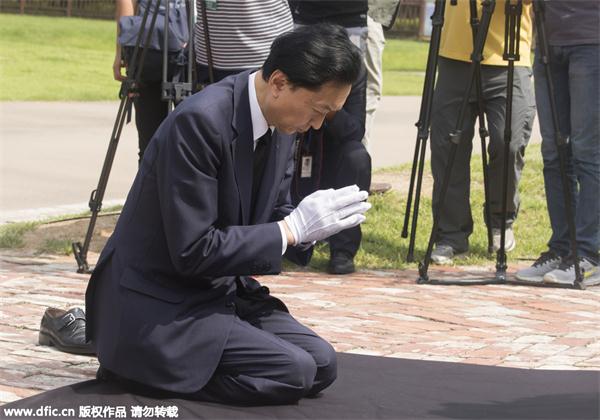
Japan′s former Prime Minister Yukio Hatoyama bows in front of a memorial stone during his visit to the Seodaemun Prison History Hall in Seoul, South Korea. [Photo/IC] |
A sincere apology from revisionist Japanese Prime Minister Shinzo Abe in his speech on Friday, a day ahead of the 70th anniversary of the end of World War II on Aug 15, would help put his long controversial views on history behind him and help the region move forward.
Yet, no one is really sure whether Abe will use the words "heartfelt apology" as former Prime Minister Tomiichi Murayama did in 1995 in what is now known as the Murayama Statement, or indeed if Abe is going to apologize at all.
If an apology is too much for Abe to express his "remorse" for the brutal Japanese militarism which inflicted huge sufferings on people in neighboring countries before and during WWII, it means whatever he is going to say to build bridges will be insincere.
It is extremely dangerous for someone harboring such problematic views on history to dramatically change the Japanese pacifist Constitution and allow its Self-Defense Forces to fight overseas for the first time in 70 years.
The massive public protests against the security bills when passed by the lower house of the Japanese Parliament on July 16 have sent a strong message that Abe does not have the support of the Japanese people. More than half of the Japanese public opposes the bills and Abe's approval rating has since plummeted, a clear indication that the bills are against the will of most Japanese people.
The new security bills have also drawn serious concerns from people in China and the Korean Peninsula, who suffered the most from Japanese past militarism. They wonder in what direction Abe intends to lead Japan.
Meanwhile, Japan's ally the US has, on the whole, kept silent about Abe's abhorrent views of history, but voiced strong support for his unpopular new security bills.
Top US officials, from President Barack Obama to Secretary of State John Kerry, like to play the role of moral leader by finger-pointing at everything, but they have not pointed their fingers at Abe's denials of Japan's war crimes, which are also hugely disrespectful to the tens of thousands of Americans who sacrificed their lives during WWII fighting the Japanese.
In fact, double standards are common practice for the US government for the sake of its geopolitical interests. For example, the US government also kept silent when the Japanese government greatly altered the status quo by nationalizing the Diaoyu Islands in the East China Sea in 2012, thereby triggering the present tensions in the region.
The US government's stance is clear: Appeasing Abe helps guarantee Japan acts as a US proxy in the East Asia. And the US badly needs such a proxy for its rebalancing to Asia strategy at a time when it is cutting its defense budget. So expanding Japan's Self-Defense Forces is great news for the US.
On the other hand, the new security bills have helped Abe fulfill his long-term goal to expand Japan's military, something his grandfather Nobusuke Kishi dreamed of a long time ago. Kishi was convicted of Class-A war crimes, but became Japan's prime minister in the late 1950s.
In this sense, Abe needs the US government's backing to realize his family dream. And this probably explains why Abe has not even got angry after recent reports show that the US National Security Agency has long been spying on him, his ministers and Japanese corporations.
Whatever Abe says on Friday, he is a leader with a distorted view of history and an expanding military, which is a dangerous combination.
The author, based in Washington, is deputy editor of China Daily USA. chenweihua@chinadailyusa.com
Related Stories
Copyright 1995 - . All rights reserved. The content (including but not limited to text, photo, multimedia information, etc) published in this site belongs to China Daily Information Co (CDIC). Without written authorization from CDIC, such content shall not be republished or used in any form. Note: Browsers with 1024*768 or higher resolution are suggested for this site.
License for publishing multimedia online 0108263 Registration Number: 130349