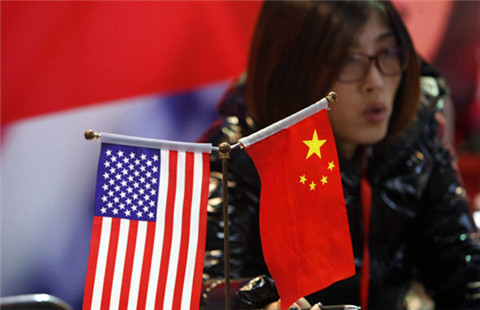
China's foreign policy has been undergoing some positive changes in order to allow it to play a bigger role in Asia and the West Pacific region. The changes gained pace after President Xi Jinping pushed for the implementation of the "Belt and Road Initiative", which he proposed in 2013, and advocated Asian people's leadership in Asian affairs at the Conference on Interaction and Confidence-Building Measures in Asia at Shanghai in May 2014.
Besides, the Beijing-led Asian Infrastructure Investment Bank and the Free Trade Area of the Asia-Pacific, proposed at the 2014 Asia-Pacific Economic Cooperation summit, also indicate China is working hard to widen its global influence. In particular, the FTAAP, may create difficulties for the Washington-led Trans-Pacific Partnership Agreement, which is still being negotiated by 12 countries.
To a certain extent, Beijing's efforts to play a greater role in the Asia-Pacific affairs can be categorized as "military strategy" and "economic strategy". The former, including Beijing's US policy, military competitions and frictions with the US and Japan, and the strong stance on the South China Sea and East China Sea issues, plays a key role in strengthening China's "hard power", which allows it to assert itself on its sovereignty and maritime rights and interests.
But a tough posture could leave China with little maneuvering room to use its soft power, and could increase the risk of confrontation with the US and Japan. That's why China should accord equal importance to the "economic strategy" based on its economic and financial power, as well as extensive diplomacy to balance its global image in the coming years.
It is likely that the strategic competitions and differences between China and the US and its regional allies like Japan could subside and involve more cautious considerations from all parties, especially the US. All the same, China has to soften some of its assertive claims and convince some neighboring countries of its peaceful rise, leaving little leeway for the US to forge a "contain-China front" in Asia.
China needs to remain candid to earn the trust of its neighbors, instead of swearing by selflessness or claiming to occupy the moral high ground. And it cannot emphasize enough that a prosperous and safe neighborhood is conducive to China's peaceful development.
Moreover, Beijing should fully respect the religious beliefs of the peoples along the Silk Road Economic Belt and the 21st Century Maritime Silk Road, and should not make them feel compelled to accept Chinese aid. But it also has to convince all the governments along the trade routes of the necessity of participating in and negotiating the transnational projects.
China also has to emphasize that the Silk Road Economic Belt, which stretches northwest from its coastal region through Central Asia to Europe, is not part of a regional economic integration which demands that countries compromise their sovereignty or accept foreign military presence on their soil.
The "Belt and Road Initiative" can be pushed forward only after fully understanding what the countries along the routes really want. So instead of focusing on trade exchanges and one-sided investments, China should make more efforts to eliminate the security risks and encourage cultural and talent exchanges.
On the basis of fair distribution of benefits, which favor relatively less developed economies, the "Belt and Road Initiative" could be transformed into an excellent example of international cooperation, allowing transnational enterprises even from countries not along the routes to take part in the projects. Once this is done, the initiative will not only clear the doubts which some states far from the two routes have about China, but also serve the interests of medium and small countries that are directly involved.
Notably, the balance between China's strategic momentum and caution plays a central role in deciding the country's strategic focus. In other words, Beijing should consider all aspects of its strategic moves on the basis of definite and justified priority.
The author is director of the Center of US Studies at Renmin University of China.
Related Stories
Copyright 1995 - . All rights reserved. The content (including but not limited to text, photo, multimedia information, etc) published in this site belongs to China Daily Information Co (CDIC). Without written authorization from CDIC, such content shall not be republished or used in any form. Note: Browsers with 1024*768 or higher resolution are suggested for this site.
License for publishing multimedia online 0108263 Registration Number: 130349