 |
|
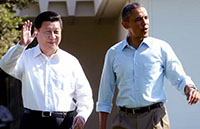
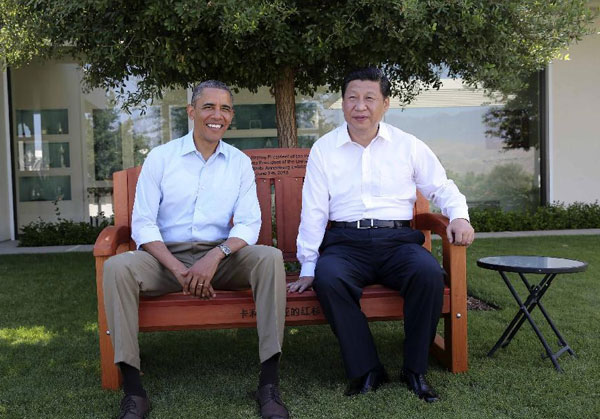
US President Barack Obama and Chinese President Xi Jinping rest during a tour at the Annenberg Retreat, California, June 8, 2013. [Photo/Xinhua] |
Editor's Note: Organized by the Beijing-based University of International Relations on July 4-5, the international symposium on "Shared Security: World Peace & Global Governance" saw more than 70 scholars from home and abroad sharing their opinions. Following are the comments of some of the scholars:
Continue world order reform
As a key participant in and protector of the current world order, China has benefited and will benefit more from it. When China launched its reform and opening-up in the late 1970s, it was a marginalized economy with per capita GDP of barely $400. Now, with per capita GDP of nearly $8,000, it has become the largest trading partner of many countries.
Yet for China, the world order is not perfect, for it is supposed to play a bigger role in pioneering new agendas, instead of just being a passive participant. Holding the largest foreign exchange reserves in the world, China needs to have a bigger say in the global monetary system, which the Beijing-led Asian Infrastructure Investment Bank could help provide.
Besides, the modern maritime law, which does not meet many emerging powers' requirements, has made it difficult for China to safeguard regional stability and protect its legal maritime rights. However long it takes, China should keep participating in the reform of the global system for shared security.
Wang Yizhou, deputy dean of the School of International Studies at Peking University.
Cooperation holds the answer
Washington's attempts to contain China have proved futile and will not work in this century. Unlike the Soviet Union, China has been engaged in regular economic exchanges with the United States on an equal footing. The US policy of containing China, if there is one, does not serve the primary interest of countries in the Asia-Pacific region.
Apart from its declining military expenditure in recent years, the US government has a lot more to deal with at home, such as its isolationism mentality. Moreover, for the US, which has never succeeded in transforming another country, the most pressing issues are still in the Middle East.
On the other hand, China, as a beneficiary of the current world order, will not seek to confront the US. It cannot replace the US in global and regional governance, because it still has to resolve many domestic issues. Therefore, both countries should honor the "new type of major-power relationship" espoused by Chinese President Xi Jinping, and uphold mutual respect and win-win cooperation rather than engaging in confrontations.
Zhao Suisheng, executive director of the Center for China-US Cooperation at the University of Denver.
Coordination key to global trade
The world has been facing a slew of grave challenges, including civil wars and poverty, since the end of the Cold War in the early 1990s. Unfortunately, global governance has failed many times because of the distance between emerging powers and traditional major powers and the low representation of the former in the global mechanism.
The postwar global order has seen two major changes. The first is the decentralization of power, because efficient global governance largely depends on proper communication and cooperation between emerging economies and major powers. And the second is in the scope of security, as the world now faces an increasing number of non-traditional threats, including climate change and the epidemics like Ebola, which are as dangerous as the traditional ones.
Therefore, the healthy development of the global economy depends on closer coordination among all countries, given their increasing interdependence.
Qin Yaqing, president of China Foreign Affairs University.
Manage differences with care
As a key variable of the ever-changing world order, the China-US relationship since the beginning of the Cold War in the late 1940s can be divided into three stages. In the first stage, China-US relations varied mostly according to the direction of the Cold War. Yet in the later stage, they became a major factor in ending the long-standing West-East confrontation. To some extent, without the reconciliation between China and the US, it would have taken longer for the latter to claim "victory" in the Cold War.
At present, the third stage of China-US ties, China is the world's second-largest economy, making the bilateral ties a decisive variable of the future global system. Of course, the reciprocal coexistence might not come easily for both countries, which are likely to end up being "partners based on functionality". That being said, bilateral ties can remain promising if the two sides properly manage (and shelve some of their) differences.
Jin Canrong, deputy dean of the School of International Studies at Renmin University of China.
Geopolitical consensus needed
In Beijing's experience, a safe and sustainable geopolitical situation can be achieved only through peaceful cooperation between maritime and landlocked countries. In essence, their cooperation should be able to forge sound geopolitical ties among countries that favor long-term regional and global development.
If all countries in Asia can reach a consensus on geopolitical issues, the number of major strategic confrontations along the Eurasian rim will significantly reduce, making the regions more conducive to China's "Belt and Road Initiative".
Unlike traditional geopolitical theories, the benign integration of landlocked and coastal states represents an open universal system characterized by reciprocity, inclusiveness and sustainable security shared by all countries. This will help Beijing's efforts to implement the "Belt and Road Initiative" without triggering regional clashes and wars.
Liu Jiangyong, deputy director of the Institute of Modern International Relations at Tsinghua University.
Related Stories
Copyright 1995 - . All rights reserved. The content (including but not limited to text, photo, multimedia information, etc) published in this site belongs to China Daily Information Co (CDIC). Without written authorization from CDIC, such content shall not be republished or used in any form. Note: Browsers with 1024*768 or higher resolution are suggested for this site.
License for publishing multimedia online 0108263 Registration Number: 130349