History must not get in the way of relations
Updated: 2015-04-24 07:31
By Zhang Haizhou (China Daily)
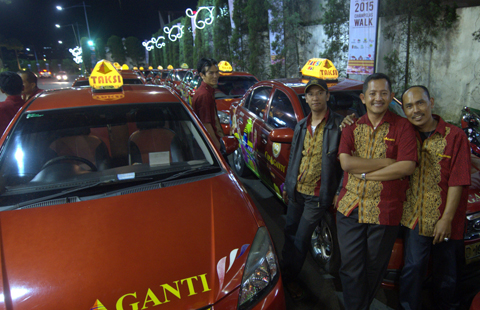
Comments Print Mail Large Medium SmallIt is often said that taxi drivers are cultural ambassadors who hold a mirror up to a nation's psyche, warts and all. And that seemed to be the case with the driver of our Bluebird taxi, stuck in Jakarta's extremely congested and cacophonous traffic on a sizzling hot afternoon.
Buses belched like volcanoes; motorcycles buzzed noisily through traffic like giant insects; policemen blew whistles to guide cars. Staring impatiently at the policemen while blasting his horn, Dudi, our 28-year-old driver, suddenly cursed in a mixture of heavily accented English and broken Chinese.
His outburst sliced through the frustrated silence in the taxi, and it made all of us laugh. His chosen Chinese curse is arguably the most frequently used slang word among my countrymen.
"Do you speak some Chinese? Who taught you?" I asked, once the laughter had died down.
"Just very little ... I learned it from by boss. He is Chinese," Dudi replied, chuckling.
"Zhongguo (China), Zhongguo Ren (Chinese). I love China. You Chinese love karaoke," he continued, still speaking in a mixture of accented English and broken Chinese. He then began to hum as if to impersonate a karaoke session.
My colleagues and I often mused over this short episode in Indonesia's capital in the days that followed. At least to some extent, it reflects the influence of Chinese language and culture, though there are arguably far better ways in which it appeals to Indonesia's population.
In addition to government-led measures - such as the opening of Confucius Institutes to promote Chinese language and culture - cultural exchanges between Indonesia and China also take place actively through people-to-people channels.
Such interactions play a crucial role in improving national images and deepening mutual understanding. Indonesia's uniquely important location, huge market and rich resources make it an exceptionally attractive destination for investors from China and other countries.
Already, many countries have opened official cultural promotion bodies in the Southeast Asian archipelago in addition to enterprises.
China, compared to others, may have a better foundation to promote its culture in the region.
Chinese began to migrate to Indonesia as far back as 2,000 years ago, and around 20 million Chinese-Indonesians now live in the country, whose total population is about 250 million.
Last year alone, the country attracted more than 1 million tourists from China.
It may sound hackneyed to call for a further deepening of ties between the two countries through cultural exchanges when the situation seems so favorable. But continuous efforts to strengthen the cultural exchanges between China and Indonesia are indeed necessary.
Many people in China, including some of my friends, would label Indonesia as "rather anti-China", and refer to the widespread riots in May 1998 against ethnic Chinese. The riots are also the first autosuggestion on Baidu.com, the leading search engine in the Chinese mainland, when you key in "Yinni", meaning Indonesia.

History should never be forgotten, but it must also not be a hurdle for prospective collaborations, particularly when Beijing is making a great effort to strengthen ties with Indonesia, the biggest and fastest growing economy in Southeast Asia.
Perceptions and understanding do matter.
"Chinese investors need to know Indonesia more, and Indonesians need to know China more," Shofwan Al Banna Choiruzzad, a scholar of international relations at the University of Indonesia, said.
I, too, can only hope my countrymen make better use of the solid foundation of Chinese culture in Indonesia.
And I also hope Dudi will speak more Chinese slang, not just swear words, when we meet again, maybe during my future visits to Indonesia.
Contact the writer at zhanghaizhou@chinadaily.com.cn
Schedule
Chinese President Xi Jinping will visit Pakistan and attend the Asian-African Summit and activities commemorating the 60th anniversary of the Bandung Conference in Indonesia from April 20 to 24.
April 22
Attend the opening ceremony of the Asian-African Summit;
Meeting with Indonesian President Joko Widodo;
April 23
Bilateral meetings;
Attend the closing ceremony of the Asian-African Summit;
April 24
Historical walk from Savoy Homann Hotel to Gedung Merdeka;
Attend activities commemorating the 60th anniversary of the Bandung Conference;

Feature