Xi says China strengthens its nuclear security system
Updated: 2014-03-25 12:28
By Wu Jiao in the Hague, Pu Zhengdong in Beijing and Chen Weihua in Washington (China Daily USA)
Comments Print Mail Large Medium SmallChinese President Xi Jinping told the third Nuclear Security Summit (NSS) that China will continue to strengthen its nuclear security capability, and stay firmly committed to building the international nuclear security system and supporting global cooperation.
In a speech to the summit meeting in The Hague on Monday, Xi said the use of nuclear energy gave new impetus to the progress of humanity, yet mankind must be able to respond to various nuclear security challenges, and ensure the safety of nuclear materials and facilities.
While giving details of China's approach to promoting nuclear security, he said the world should place "equal emphasis" on development and security, and develop nuclear energy on the premise of security.
|
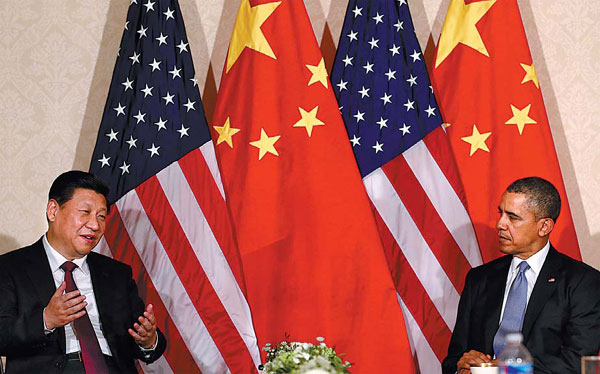
President Xi Jinping meets with his US counterpart Barack Obama on the sidelines of the Nuclear Security Summit in The Hague on Monday. Kevin Lamarque / Reuters |
He warned that developing nuclear energy at the expense of security can neither be sustainable nor bring real development.
Xi urged all nations to fulfill their duties under international legal instruments regarding nuclear security, and implement relevant UN Security Council resolutions.
"While addressing the importance of countries honoring their international obligations, we should respect their right to adopt nuclear security policies and measures best suited to their specific conditions," said Xi.
Xi also noted that nuclear security remains a global endeavor, urging that more countries should be brought into the international nuclear security process.
"We should strengthen exchanges to learn from each other and share experience, and improve coordination between the relevant multilateral mechanisms and initiatives," he added.
According to Xi, to effectively eliminate risks of nuclear security and nuclear proliferation, the international community should improve relevant policies and measures, develop modern, low-risk nuclear energy technologies, maintain balanced supply and demand of nuclear materials, strengthen non-proliferation efforts, and promote international cooperation against nuclear terrorism.
China has tightened nuclear security measures, improved technology and emergency response, and conducted comprehensive nuclear security checks on nuclear facilities across the country, Xi added.
The NSS, initiated by US President Barack Obama, has become an important platform to address nuclear security issues. Its first meeting was held in Washington in 2010. The second meeting was held in Seoul in 2012.
In an hour and a half meeting prior to the start of the two-day summit, Xi and Obama pledged to increase cooperation between the two countries.
Xi told Obama that "China is willing to work with the United States to keep the two nations on the right path toward building a new type of major-country relations."
The Chinese leader said he appreciated a similar commitment from the US in a letter he received recently from Obama.
Beijing will remain committed to the position of non-confrontational actions, mutual respect and win-win cooperation, Xi said.
Obama said the US has no intention of damaging China's stability or containing China's development, and instead it supports China's reforms.
Obama also said that the US is willing to handle the frictions in bilateral ties through constructive ways.
"The two countries not only work on issues of mutual interest and concern, but are also able to work through frictions that exist in their relations such as human rights, or dealing with maritime issues in the South China Sea and the Pacific region in a way that is constructive and hopefully will lead to resolutions and solutions for all parties," Obama said.
Ben Rhodes, the US Deputy National Security adviser for Strategic Communications, said that the two presidents' discussion touched on issues including the missing Malaysian Airlines Flight 370, climate change, North Korea, Iran, Ukraine, bilateral economic issues, the increased military exchanges, maritime security and counterterrorism and cyber security,
Rhodes said that on cyber security Xi did raise the issue of recent reports regarding the National Security Agency's activities against China, referring to NSA's hacking into China's telecom giant Huawei Technologies.
Orville Schell, director of the Center on US-China Relations at the Asia Society, said if the idea expressed last year at the Sunnylands meeting of seeking to establish some kind of "a new model of big power relations" is ever to be made real, it will be necessary for both sides to set aside some of the historical suspiciousness with which they have approached each other.
"Indeed, there were moments during the past three decades when we did succeed in doing so, but it will now take real leadership, even a little innovative risk taking, for our two presidents to do so anew," Schell said.
"But, if they fail, the world will then also fail in resolving a range of critical global problems such as nuclear proliferation, climate change, pandemics and other challenges that can only be met multilaterally."
Contact the writers at wujiao@chinadaily.com.cn, puzhendong@chinadaily.com.cn and chenweihua@chinadailyusa.com