Chinese German investment 'will remain robust'
Updated: 2013-09-24 06:40
By Li Jiabao (China Daily)
Comments Print Mail Large Medium SmallChina's ODI in the European country surged 56 percent year-on-year to $799 million in 2012
Chinese investment in Germany will maintain its robust momentum in the near future while auto parts manufacturing is likely to become an emerging sector under more mergers and acquisitions from Chinese enterprises chasing advanced technology, analysts said on Monday.
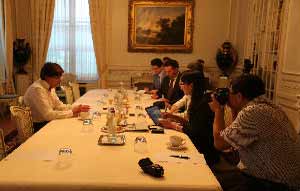
"China is now entering more and more developed countries, particularly Germany. For the time being, the total proportion is still moderate. What is important is the trend. The trend is still going up," Martin Broda, general manager of the Beijing Branch of Commerzbank, told the Investing in Germany China Roadshow 2013, held in Beijing on Monday.
Markus Hempel, China Representative of the Investment Promotion of Germany Trade & Invest, echoed the view that Germany is now the main destination in Europe for Chinese investments following strong growth of Chinese foreign direct investment in Germany over the last years.
"As the leading economy of the EU, Germany provides an outstanding investment environment for foreign companies in view of its first-class infrastructure, power of innovation, inviting incentive and high productivity," Hempel said.
Chinese outward direct investment in Germany surged 56 percent year-on-year to $799 million in 2012, accounting for 13.1 percent of China's overall overseas direct investment in the European Union. The accumulated value of China's ODI in Germany increased from $129.21 million at the end of 2004 to $3.1 billion by the end of 2012, according to the 2012 Statistical Bulletin of China's Outward Foreign Direct Investment.
China's strategy of encouraging domestic companies to go abroad, launched in 2000, trigger an upswing in China's outward FDI and helped the economy into an innovative track, Broda added.
"Chinese companies need to increase their role in the international market. After a phase of exporting their products abroad, now they are in a second stage of producing abroad. And it's a natural thing for Chinese companies to go out globally. Clearly the move is very strong," said Sebastian Daub, a partner of corporate/M&A at Linklaters, one of the leading law firms in Germany.
" China is the second largest economy. We are only seeing the start of it. As the economy matures and Chinese companies get more familiar with the German market and the right investment and communication strategies, there will be more Chinese investment in Germany."
Chinese entrepreneurs said that Germany offers the best conditions for establishing headquarters, research, logistics and production while other industrialized countries such as France and the United Kingdom trailed by a wide margin, according to a survey by Ernst & Young on 400 managers of Chinese large companies in the period from April to May 2012.
China was the third-largest investor in terms of projects in Germany in 2012, following the United States and Switzerland, Hempel said.
Broda added that Chinese outward FDI in Germany focuses on three key industries: automotive, industrial machine and equipment; electronic and semiconductor; consumer products (including food and beverages), accounting for 62 percent of total Chinese outward FDI in Germany.
In 2013, GA Pack, a China-based manufacturer of aseptic packaging, planned to invest a further 38 million euros to build a second production line in Germany after investing 50 million euros to build a European production facility in 2011.
"In the near future, Chinese companies will carry out more M&As in the sector of auto parts in Germany. The overseas M&As of Chinese companies are now very purposeful and they aim at acquiring core technology in the EU or Germany. The German plants of auto parts, mostly family businesses, are troubled by capital shortages or lack of inheritors," said Huang Qun, a partner at Taylor Wessing.
He added Chinese enterprises during cross-border M&As may face risks from the differences in language, cultural and business models, which will lead to mistrust and significantly decide the ultimate success of the transactions.
lijiabao@chinadaily.com.cn