Larger role seen for China
Comments Print Mail Large Medium Small
Neighbors expected to agree on growth agendas during Mekong summit
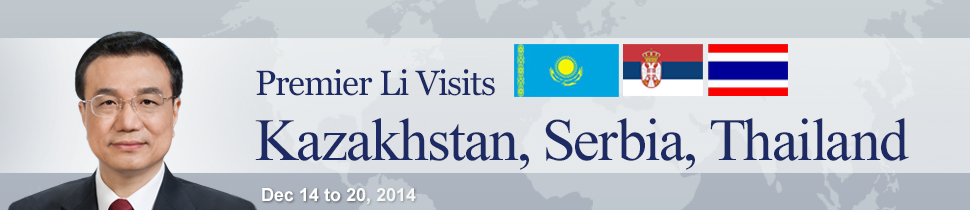
Experience in sustainable development, close economic ties and proximity to the Greater Mekong Subregion will help China play an increasingly important role in the area's development, officials and analysts predicted on the eve of a key meeting that will be attended by Premier Li Keqiang.
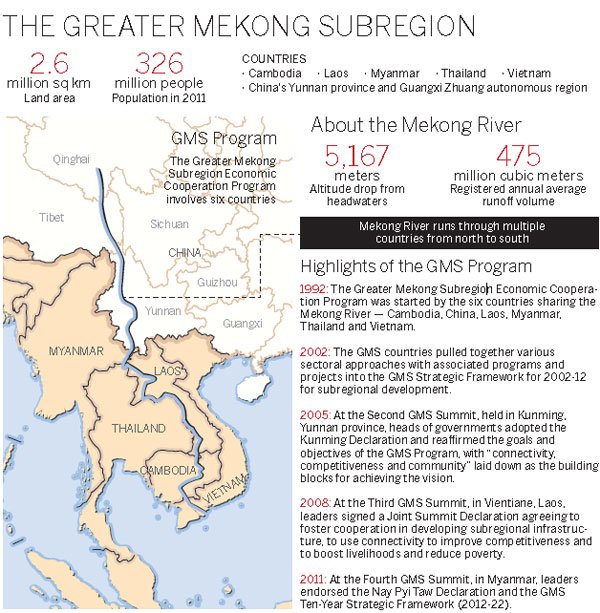
The Greater Mekong Subregion Economic Cooperation summit in Bangkok on Friday and Saturday, focusing on "inclusive and sustainable development", is set to endorse a number of initiatives, including a Regional Investment Framework (2013-22) and the Implementation Plan (2014-18).
The Foreign Ministry said that the summit will identify 92 priority investment projects. A regional rail alliance and an assessment report on regional transportation strategy from 2006 to 2015 will also be discussed.
"China expects to reach a consensus with other members on development agendas," said Wang Chao, vice-foreign minister.
Li Hong, the Chinese permanent representative to the United Nations Economic and Social Commission for Asia and the Pacific, said that in the past 30 years, China has gained considerable experience in development, and this can be passed on.
"Meanwhile, as the second-largest economy in the world, the government also knows about the importance of sustainable development," Li said.
Founded in 1992, the Greater Mekong Subregion has overseen a number of investment programs allowing it to not only be a conduit for regional cooperation, but also a good communication channel for policymakers, he added.
In 2013, trade volume between China and its fellow GMS members reached $153.4 billion, and direct investment from China to the five other member countries rose to $2.3 billion, the Ministry of Commerce said.
"The other five members are neighboring countries, and are able to benefit the most from China's development," Li said, adding that as all five other countries are members of the Association of Southeast Asian Nations, China can use the Greater Mekong Subregion to help upgrade its relationship with the bloc.
"More than providing capital and technology for infrastructure, China, as the most influential power in the GMS, can also be a leader of policy connectiveness among the countries," Li said.
The priority is to improve physical connectivity, but after the construction of roads and railways, trade zones and special economic development regions could blossom, he added.
Zhou Yongsheng, a foreign policy expert at Beijing-based China Foreign Affairs University, said that cooperating with China through organizations like the GMS will help the member countries realize a more balanced development.
Related Stories
28th joint Mekong patrol concludes 2014-11-21 16:29
Vietnam's Mekong delta sees sharp rise in rice exports 2014-11-11 17:18
Patrols bring security to Mekong River 2013-12-17 07:14
Chinese projects in Mekong River basin hurt environment: report 2013-08-28 17:13
2,534 arrested in Mekong anti-drug campaign 2013-07-02 16:05
Joint anti-drug campaign on Mekong River begins 2013-04-19 13:23
Premier Li visits Kazakhstan, Serbia, Thailand 2014-12-15 15:04
Li to begin tour of Kazakhstan, Serbia, Thailand 2014-12-13 08:03
Background