
Common trade rules called for among APEC members
Updated: 2014-11-06 21:21
(Xinhua)
|
||||||||||


BEIJING - Common trade rules are needed in the Asia-Pacific region as businessmen have complained about different regulations that make trade complicated, experts said Thursday.
"There are 56 free trade agreements (FTAs) in the Asia-Pacific region, and there is the possibility of a fragmentation of the trading system," said Zhang Shaogang, director-general of the international trade and economic affairs department under China's Ministry of Commerce.
Both bilateral FTAs and mega-FTAs are aimed at cutting tariffs and reducing investment barriers, but the increasing number of FTAs has also created the "spaghetti bowl" dilemma, Zhang said at a press briefing prior to the Asia-Pacific Economic Cooperation (APEC) Ministerial Meeting slated for Friday.
He compared the overlapping FTAs to different nations' traffic regulations upon which international travellers frown.
Mega-FTAs refer to trade talks comprising a large number of economies like the Trans-Pacific Partnership (TPP) and Regional Comprehensive Economic Partnership (RCEP).
Chinese companies need to cope with different trade rules when doing business with partners from the Republic of Korea, Chile and other countries, adding to their operational costs, which has become an "institutional barrier" for them, he noted.
The region's mushrooming free trade pacts resulted in mounting complexity and costs for exporters and importers from the 21 APEC members, analysts said.
"If there are common global trade traffic regulations or common Asia-Pacific trade traffic regulations, it will be much easier for companies to do businesses overseas," Zhang said.
Senior officials from APEC members agree to strengthen interaction and information sharing among the TPP, RCEP and other FTAs, and comprehensive and strategic studies of establishing the Free Trade Area of the Asia-Pacific (FTAAP) might be conducted, Zhang said after discussing an array of economic and trade topics with senior officials from other APEC economies.
The realization of FTAAP is a long-standing consensus and vision of APEC economic leaders. It can help consolidate the various bilateral and multilateral cooperation mechanisms in the region, and minimize the risks caused by overlapping and fragmented free trade arrangements.
If the FTAAP can be established to encompass smaller FTAs, the efficiency of a mega-FTA can be enhanced so as to help companies enjoy the benefits of trade liberalization, he stressed.
"However, establishing the FTAAP doesn't mean that we need to launch negotiations tomorrow," but different sides need to study how to coordinate talk achievement of TPP and RCEP in the future to pool efforts together and avoid the "spaghetti bowl" dilemma, Zhang noted.
The FTAAP is not a new idea, and it should be able to accommodate all APEC members, said Zhang Jianping, a senior researcher with the Institute for International Economic Research under the National Development and Reform Commission (NDRC), China's top economic planner.
Both TPP and RCEP can both become "important pillars" of the FTAAP, and the FTAAP should "provide space to both developed and developing countries and make them feel welcome," he stressed.
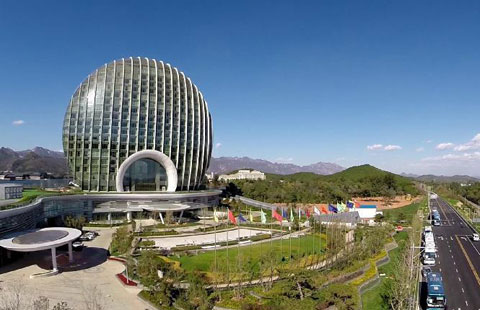
China is APEC host this year. A series of APEC meetings bearing the theme "Shaping the Future through Asia-Pacific Partnership" will be held from Nov. 5 to 11 in Beijing.