
Bloc to reduce burdens for smaller businesses
Updated: 2014-05-15 07:12
By Yao Jing in Qingdao (China Daily)
|
||||||||||


APEC member economies called for policy support to ensure that small and medium-sized enterprises contribute more to global value chains, which are becoming increasingly important in international trade.
"In recent years, we have seen the simultaneous integration of trade and the disintegration of production as multinationals increasingly rely on a variety of SME suppliers throughout the region during their production process," said Alan Bollard, executive director of the APEC Secretariat.
Bollard made the comment at the APEC Committee on Trade and Investment meeting of the APEC Policy Support Unit in Qingdao, Shandong province.
|
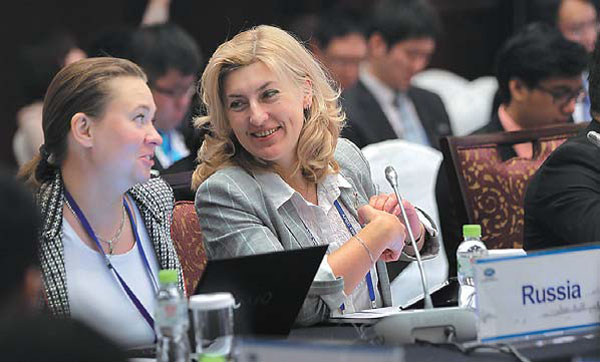
Russian representatives attend the APEC meeting in Qingdao on Wednesday. Zou Hong / China Daily |
Meanwhile, regional value-chain links are becoming more significant as Asia-Pacific Economic Cooperation member economies go through different stages in developing global value chains.
Developing countries' share of global value-added trade increased from 20 percent in 1990 to 30 percent in 2000 and to over 40 percent currently. However, many developing countries are still struggling to gain access to the chains beyond resource exports, according to the World Investment Report 2013.
"To help SMEs meet standards and obtain certificates, APEC member economies could harmonize standards and conformance procedures, set up public certification systems to reduce the burden on SMEs to obtain certificates and provide training and technical assistance on qualification and certification processes," said Denis Hew, director of the APEC Policy Support Unit.
This is particularly important as relations between member economies develop further.
Economies seeing increasing labor costs, including China, face the problem of shifting production lines.
Song Hong, an economist at the Institute of World Economics and Politics under the Chinese Academy of Social Sciences, said an improved system to meet this challenge is required.
"Most of these manufacturers are SMEs, and it is urgent for member economies to build a system to facilitate these players," Song said.
With the expansion of global trade, there has been a structural change in global value chains.
"The transition includes consolidation by multinationals into a few large suppliers, as well as the rise of e-commerce, enabling further expansion of global value chains," said John Larkin, chairman of the trade and investment committee.
In fact, global trade is increasingly driven by global value chains.
About 60 percent of global trade, worth more than $20 trillion, consists of trade in intermediate goods and services that are incorporated at various stages in the production process of goods and services for final consumption, the 2013 investment report said.
The policy support unit also conducted an analysis of the prospects for SMEs to engage in global value chains in five main sectors: agriculture, food processing, automobiles, electronics and handicrafts.
"The analysis shows, for example, that SMEs in developed and newly industrialized economies have a higher potential to participate more fully in global value chains in the agriculture and electronics sectors," said unit analyst Zhang Yuhua.
For SMEs in developing economies, the electronics and handicraft sectors offer better opportunities for capturing a larger role in global value chains, Zhang said.
yaojing@chinadaily.com.cn