 |
|
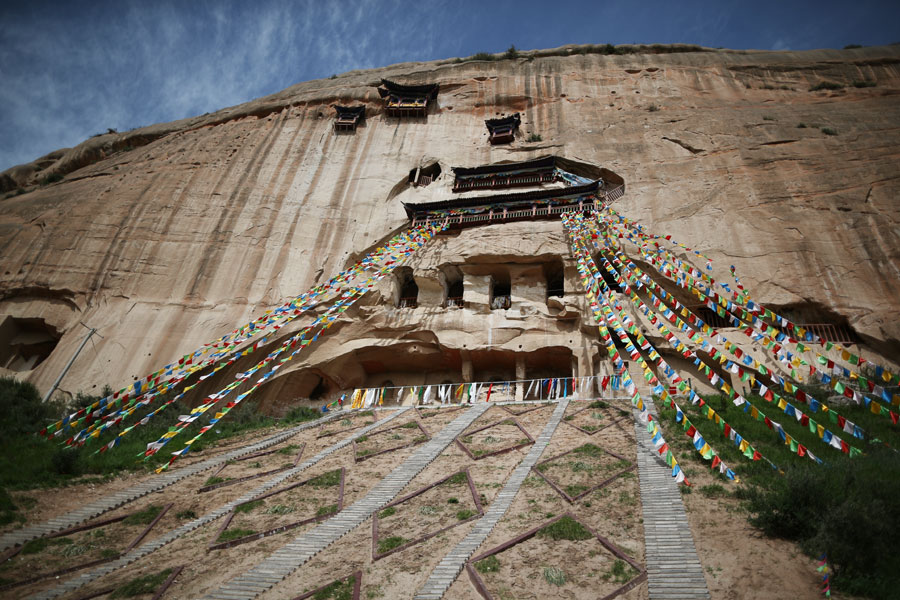
The Matisi Grottoes cover about 100 square kilometers in Sunan, a Yugu ethnic autonomous county 600 kilometers from Gansu's provincial capital Lanzhou. Mati means "horse hoof" and si means "temple". The first caves were dug about 1,600 years ago. Most were chiseled into temples, such as the North Matisi Grottoes carved into a 100-meter-high cliff. The 21 caves are arranged in seven stories. Visitors climb narrow stone stairs to see the top grotto's Bodhisattva Lyudumu in a shrine. Every story contains statues.[Photo by Chen Xi/China Daily]
|
A legendary Eurasian route for trade and cultural communication between the East and the West has finally been acknowledged as a common treasure of human civilization.
China gained its 46th World Heritage Site designation on Sunday after the UNESCO's 38th session of the World Heritage Committee in Doha, Qatar, approved a portion of the Silk Road to be included in the list.
The successful international application of "The Silk Roads: The Initial Section of the Silk Roads, the Routes Network of Tian-shan Corridor" — which involves China, Kazakhstan and Kyrgyzstan — thus becomes one of the biggest items on the list in terms of geographic distribution.
The main line of this ancient route was in use from the second century BC to the 16th century and stretched for more than 7,000 kilometers at its zenith.
"It turns a new page in terms of World Heritage Sites because our previous items on the list are individual spots rather than a continuous line," said Tong Mingkang, deputy director of the State Administration of Cultural Heritage and the head of China's delegation to Doha.
There are 33 historical sites in the project with 22 in China's four province-level administrative regions: Shaanxi, Henan and Gansu provinces and in the Xinjiang Uygur autonomous region, together with eight in Kazakhstan and three in Kyrgyzstan.
"A detailed plan for protection and improvement of surrounding areas was made for each spot, making this application much more complicated than previous ones," Tong said.
"The success also gave us important experience in terms of cross-border cooperation in the field."
Tong said that China would probably submit more international requests for World Heritage status in the future.
According to Lu Qiong, deputy head of the office in charge of World Heritage Protection, the steering committee of the trilateral working group held 15 meetings in China to prepare for the application. The filings had to be written in five languages, which greatly increased the workload.
UNESCO began to encourage countries along the Silk Road to join hands in bidding for World Heritage status as early as the 1990s, but the substantive work only began in 2006 because of academic disputes over which corridor was the most representative. This project defeated another route between Tajikistan and Uzbekistan in an earlier stage of evaluation.