

|
 |
|
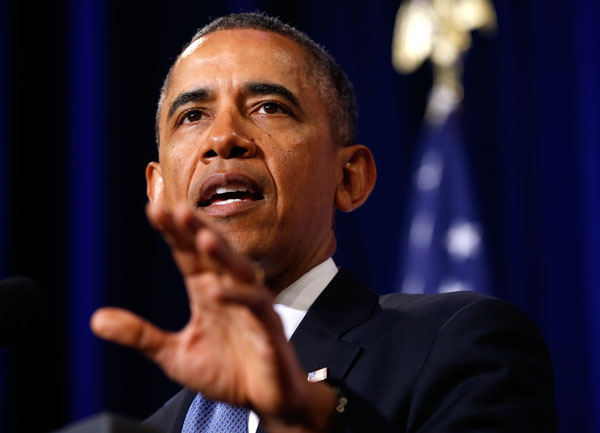
US President Barack Obama speaks about the National Security Agency from the Justice Department in Washington January 17, 2014. [Photo/Agencies] |
President Barack Obama announced a ban on US eavesdropping on the leaders of close friends and allies on Friday, and rein in the vast collection of Americans' phone data in a series of reforms triggered by Edward Snowden's revelations.
In a major speech, Obama took steps to reassure Americans and foreigners alike that the United States will take into account privacy concerns that arose after former US spy contractor Snowden's damaging disclosures about the large monitoring activities of the National Security Agency.
Obama promised that the United States will not eavesdrop on the heads of state or government of close US friends and allies, which a senior administration official said would apply to dozens of leaders.
The step was designed to smooth over frayed relations between, for example, the United States and Germany after reports surfaced last year that the NSA had monitored the mobile phone of German Chancellor Angela Merkel.
Among the list of reforms, Obama called on Congress to establish an outside panel of privacy advocates for the secret Foreign Intelligence Surveillance Court that considers terrorism cases.
While the speech was designed to address concerns that US surveillance has gone too far, Obama's measures were limited.
One of the biggest changes will be an overhaul of the government's handling of bulk telephone "metadata."
In a nod to privacy advocates, Obama decided that the government should not hold the bulk telephone metadata, a decision that could frustrate some intelligence officials.
In addition, he ordered that effectively immediately, the US government will take steps to modify the program so that a judicial finding is required before the database is queried.
Obama also decided that communications providers would be allowed to share more information with the public above government requests for data.
While a presidential advisory panel had recommended that the bulk data be controlled by a third party such as the telephone companies, Obama did not plan to offer a specific proposal for who should store the data in the future.
Obama has asked Attorney General Eric Holder and the intelligence community to report back to him before the program comes up for reauthorization on March 28 on how to preserve the necessary capabilities of the program, without the government holding the metadata.
Administration officials will consult relevant committees in Congress on how to best handle the material.
Obama is balancing public anger at the disclosure of intrusion into Americans' privacy with his commitment to retain policies he considers critical to protecting the United States.
|
|
|
|
|
|
|
|

Copyright 1995 - . All rights reserved. The content (including but not limited to text, photo, multimedia information, etc) published in this site belongs to China Daily Information Co (CDIC). Without written authorization from CDIC, such content shall not be republished or used in any form. Note: Browsers with 1024*768 or higher resolution are suggested for this site.
License for publishing multimedia online 0108263 Registration Number: 20100000002731 






















 Op Rana
 Berlin Fang
 Zhu Yuan
 Huang Xiangyang
 Chen Weihua
 Liu Shinan