Comments
  Print
Print  Mail
Mail  Large Medium Small
Japanese Prime Minister Shinzo Abe set out on his first tour of the new year on Thursday aiming to boost Tokyo's influence globally and help Japanese companies gain ground on their European and Chinese rivals in the lucrative Middle East and African markets.
Observers said Tokyo could hurt its chances of securing economic deals on the continent if it pressures African nations to take sides on political issues regarding China.
"Africa is a frontier of Japan's diplomacy and the Middle East is also extremely important," Abe told reporters before leaving for Oman, the first stop on a trip that runs through Jan 15.
Abe is not only seeking to land deals for Japanese businesses in Africa, but also to "contain China's strong influence in Africa", according to Japan's Sankei Shimbun newspaper.
"Containing China is one of Abe's intentions in his visits to Africa and the Middle East," said Yoshiie Yoda, professor emeritus at Waseda University. "He should solve Japan's problems with China rather than resort to a containment policy."
After Oman, Abe will travel to Cote d'Ivoire, Mozambique and Ethiopia, the first Japanese prime minister to visit the African continent since Junichiro Koizumi in 2006. Abe is expected to meet with Omani Sultan Qaboos bin Said and to lobby for a stable supply of oil and natural gas from the Gulf nation, according to Japanese media.
Liu Junhong, a Japanese studies expert at the China Institutes of Contemporary International Relations, said Japanese government officials are using "economic diplomacy" to boost deals with oil-rich nations in the Middle East and Africa.
"Tokyo is targeting the infrastructure industry in emerging economies as a major driving force for revitalizing the Japanese economy," Liu said.
Japanese companies accounted for only 2 percent of overall foreign direct investment in Africa in 2011, spending just $460 million, one-seventh the amount of investments from Chinese companies, the Nikkei Shimbun reported.
Africa's economy is expanding because of its natural resources. While Japanese companies were largely absent from the first wave of the global investment on the continent, a growing number are now making inroads.
Abe is expected to announce that Japan will lend about $2 billion to Africa by 2016, doubling the loan ceiling he promised at a G8 summit in 2012.
"That amount of economic aid from Japan naturally implies expected rewards, both economically and politically," said Zhou Yongsheng, a professor of Japanese studies at China Foreign Affairs University.
Kazuhiko Togo, a professor and director of the Institute for World Affairs at Kyoto Sanyo University, said, "The Japanese leader's visits have sent a clear message: Japan is now directed toward the whole world."
Before setting out on the trip, Abe drew criticism from China and the Republic of Korea by announcing that he would not rule out making another visit to the Yasukuni Shrine, where Japanese leaders convicted as war criminals after World War II are honored.
His Dec 26 visit to the shrine triggered strong rebukes from Beijing and Seoul. It also prompted the White House and various international newspapers to express their disappointment over the visit.
On Thursday, Beijing urged Abe to stop his provocations and said his goal in visiting the shrine was "to beautify the history of the militarist Japan's aggression and colonial rules".
Japan's ruling Liberal Democratic Party released a proposed party position for 2014, deleting the "pledge never to wage war again", Japan's Kyodo News Agency said on Thursday. Instead, the draft adds a phrase saying "... bolster veneration (for the war dead)", a phrase echoing Abe's excuse for the shrine visit.
Foreign Ministry spokeswoman Hua Chunying said Abe's actions have ended dialogue with China and that his recent remarks "clearly showed that he is not willing to improve the nation's relationships with its Asian neighbors".
Contact the writer at caihong@chinadaily.com.cn

 Animals gone wild
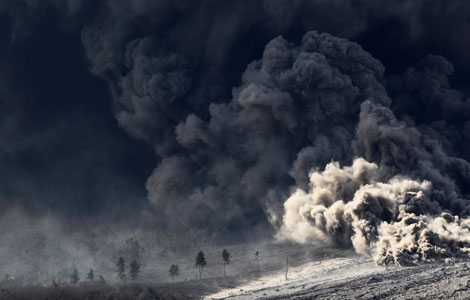 Thousands flee as Indonesia volcano erupts
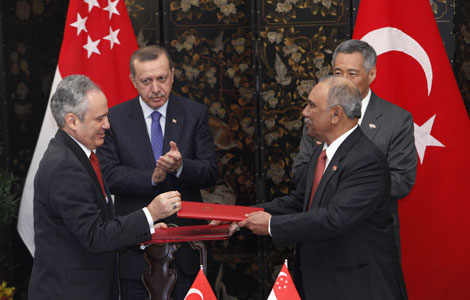 Turkey and Singapore signs counter-terrorism MOU
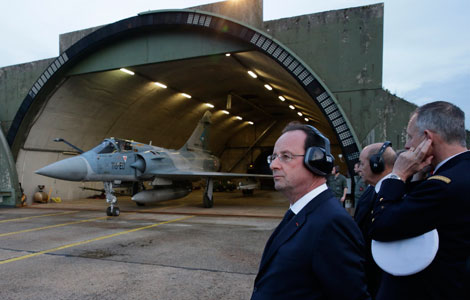 Hollande presents New Year wishes to the French Army
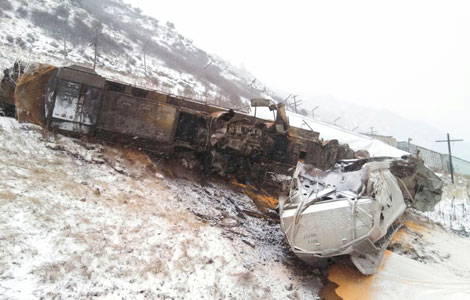 US train derails after collision
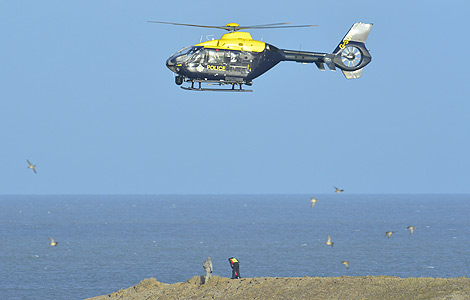 UK police pick through US helicopter crash site
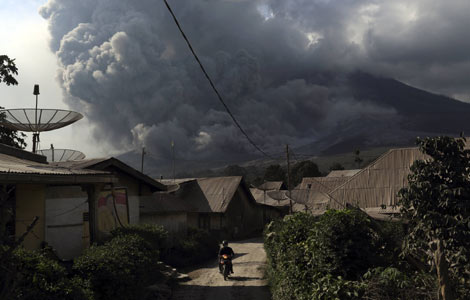 New volcano eruptions force more Indonesians to evacuate
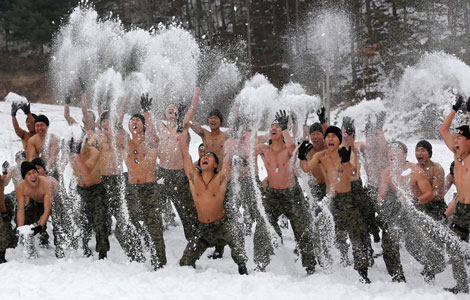 S. Korean soldiers train in the snow
Copyright 1995 - . All rights reserved. The content (including but not limited to text, photo, multimedia information, etc) published in this site belongs to China Daily Information Co (CDIC). Without written authorization from CDIC, such content shall not be republished or used in any form. Note: Browsers with 1024*768 or higher resolution are suggested for this site.
License for publishing multimedia online 0108263 Registration Number: 20100000002731