

Survey shows majority believes strong relationship is an 'important priority'
 |
The United States and China are more likely to see each other as competitors than as partners or adversaries, a survey released on Thursday shows.
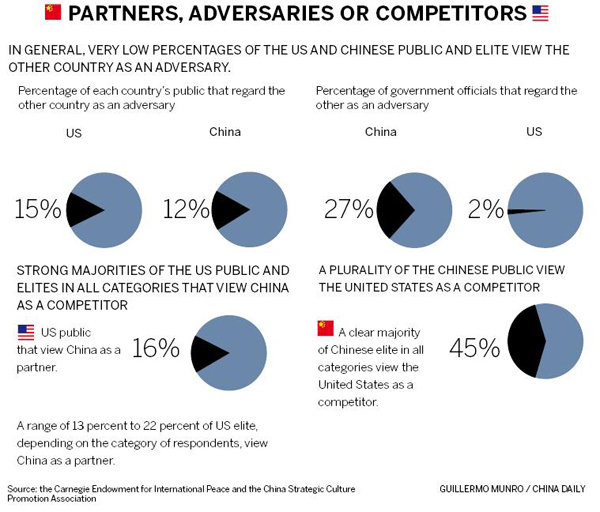
The US-China Security Perceptions Survey, released by the Carnegie Endowment for International Peace and the China Strategic Culture Promotion Association, showed that 45 percent of the Chinese public and a clear majority of the Chinese elite view the US as a competitor. The survey defined the elite as consisting of government officials, scholars, business leaders, military experts and the media.
Only 15 percent of the US public and 12 percent of the Chinese public viewed the other country as an adversary.
The figures were smaller with US elite categories, with 2 percent of government officials and 1 percent of business leaders viewing China as an adversary.
The majority of respondents from the US and China in all categories viewed the other country as a competitor, while a minority said the other nation was a partner.
One of the most disturbing findings in the report was “a high level of distrust both among elite and the public in both countries toward the other”, said Michael Swaine, lead author of the report and an analyst on Chinese security issues at the Carnegie Endowment.
Only 26 percent of the US public said China can be trusted a “great deal/fair amount”, and 13 percent of the Chinese public said the same about the US, according to the data. The authors noted that levels of trust were slightly higher for youth and scholars in both countries.
On the other hand, “there is a strong recognition of the need for the two countries to improve their relationship and to cooperate more deeply,” Swaine said at a news conference on Wednesday about the survey.
Eighty-one percent of US government officials and 94 percent of its media believe that building a strong relationship between the countries is an important priority, as did a majority of Chinese officials and media personnel.
Luo Yuan, vice-president of the China Strategic Culture Promotion Association, said mutual trust is an important factor to develop a new type of major power relations between the two countries.
“It’s no longer the zero-sum game of the Cold War time. Seeing each other as competitors is good for the two countries developing bilateral ties,” said Luo, who was the Chinese lead author of the report.
“To develop more mutual trust, both countries need to clarify their intentions. What’s the US purpose in turning to the Asia-Pacific region? What are China’s goals for its development? So far, neither side is sure about each other’s main purposes,” Luo added.
He also suggested both countries find more common interests and cooperation opportunities to enhance their understanding of each other.
“For the public, both countries’ peoples should have more programs of interaction, such as tourism and cultural exchanges. Mass media should also be responsible for more objective and balanced reports on each other,” he said.
The survey was conducted in the middle of last year among 1,004 US adults representing the general public and 305 of the US elite. In China, 2,597 Chinese adults representing the general public were surveyed along with 358 of the elite.
On the subject of global leadership, the majority of respondents said they felt their own countries should play a “shared leadership role”, but there was a “non-negligible” percentage of Chinese who thought the US should continue to play a leadership role: 19 percent of the public and 21 percent of government officials.
The Chinese responses did not “present this view of yearning to replace the US as the global superpower by any means,” Swaine said.
The results could reflect, Swaine said, that the Chinese don’t think Beijing is capable at the moment of being the sole leader, and could also “tell us that the general belief in Chinese thinking is that a dominant single power is a hegemonic power, and they see that sort of role not as one of benign leadership, but as one of lording it over other countries, and they don’t want to see China doing that.”
Contact the writer at zhaoyanrong@chinadaily.com.cn
|
|
|
|
|
|
|
|

Copyright 1995 - . All rights reserved. The content (including but not limited to text, photo, multimedia information, etc) published in this site belongs to China Daily Information Co (CDIC). Without written authorization from CDIC, such content shall not be republished or used in any form. Note: Browsers with 1024*768 or higher resolution are suggested for this site.
License for publishing multimedia online 0108263 Registration Number: 20100000002731 














 Op Rana
 Berlin Fang
 Zhu Yuan
 Huang Xiangyang
 Chen Weihua
 Liu Shinan