Connecting across Africa


 |
|
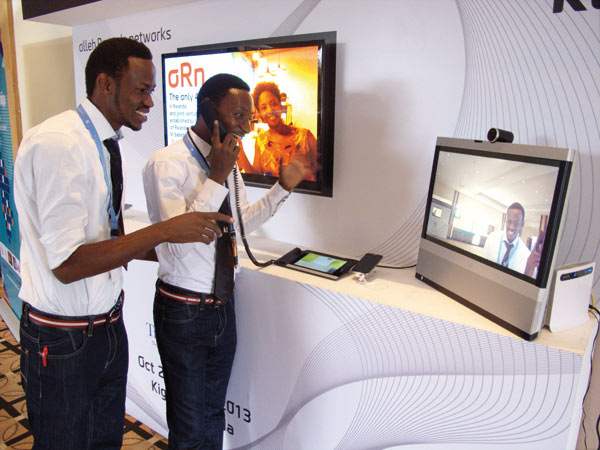
Two Africans try a visual phone at a recent exhibition in Rwanda. Li Lianxing / China Daily |
Education moves
With an eye on training local talent so that they can take up ICT careers, many leading global research institutions have established laboratories and campuses in Africa.
Last month, IBM opened its first commercial technology research facility in Africa for applied and far-reaching research. The center will assess the challenges faced by the continent and seek to come up with commercially viable innovations that can make a difference to people's daily lives.
The research agenda also includes the development of cognitive computing technologies, which integrate learning and reasoning capabilities to help experts make better decisions in areas such as healthcare delivery and financial services. According to IBM officials, Africa is also a great strategic opportunity, because it is one of the early adapters of cognitive systems.
"The research laboratory underpins the government commitment to innovation ecosystems that are already available in Kenya," says Kenyan President Uhuru Kenyatta.
"Using innovation to drive homegrown solutions, Kenya continues to lead the continent in ICT. Kenya, and the whole of Africa, will benefit from the presence of one of the most advanced research facilities, with some of the world's most talented people, using some of the most powerful technologies to develop solutions in Africa for Africa."
At the same time, some experts feel that setting up research institutes in Africa represents the next stage of ICT transformation.
"We are currently seeing the emergence of a new Africa — one where science and technology are enabling a pivotal leapfrog moment by allowing governments and businesses to drive economic growth, raise the standard of living and compete with their global counterparts," says Kamal Bhattacharya, director, IBM Research, Africa.
"The full-scale technology research facility represents a new era in African innovation and sets the tone for the continent's future scientific and economic independence."
In 2011, Pittsburgh-based Carnegie Mellon University opened its first African campus in Kigali, Rwanda, to support its ICT talents program.
Bruce Krogh, director of CMU in Rwanda, says the university decided to establish its campus in Africa after receiving an invitation from the Rwandan government in 2007.
"CMU had a lot of global locations, but certainly nothing in Africa at the time," he says. "So the university after careful evaluation and consideration signed a 10-year agreement with Rwanda in 2011."
CMU offers master's programs in information technology and computer engineering at its Kigali campus.
Chinese universities and companies are taking a more cautious route to foster ICT talent in Africa. Unlike the curriculum-based educational courses, Chinese companies are banking on an employment and training approach.
"ICT is an industry that must be highly localized and needs a lot of local talent," says Ambitho from Star Times Media. "That's why Chinese companies are paying more importance to aspects such as technology transfer to local staff and local employment."
"We have more than 400 local employees and nearly all of them need formal employment training," he says.
"There are still lots of gaps between what they learnt in school and what is required."
ICT covers a wide range of industries with differing requirements for talent, Ambitho says, adding that the digital TV industry, for instance, requires theoretical as well as practical skills.
"To improve the quality of our staff and potential employees, we are planning to open a training center in Nairobi soon. We have also been sending some staff members to China for short-term training courses," he says. "We plan to train them in leading technologies and skills."
Apart from setting up research centers, Chinese educational institutions are also furthering ICT tie-ups through increased student and faculty exchanges.
ICT-related courses such as computer science or information technology are becoming increasingly popular with African students studying in China.
Norbert Haguma, a Rwandan computer science student at Beijing Jiaotong University, says he came to China to learn but, more importantly, to understand the Chinese ICT scene.
Chen Yingqun contributed to the story.