China's US debt holdings in doubt


Experts eye cutback in China's massive stock of T-bills
More Chinese economists are beginning to sound the alarm over the risk to China of holding more than $1 trillion in US Treasury bills, as efforts by the US Congress to raise the debt limit remain elusive.
Although the top Democrat and Republican in the US Senate were said to be close to an agreement to raise the limit, the measure's fate remained unclear in the fractured Republican-controlled House of Representatives, which twice failed to produce its own plan on Tuesday.
European stocks fell on Wednesday, giving back some of the previous day's gains, after US politicians failed to agree to a deal to avoid a default. Asian markets were mixed Wednesday, as Tokyo rose 0.18 percent, Shanghai closed down 1.57 percent while Hong Kong was 0.72 percent lower.
 |
|
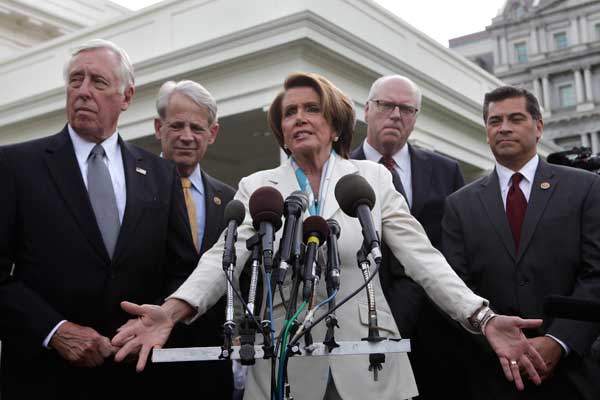
Minority Leader of the House Nancy Pelosi speaks to the media after a meeting with US President Barack Obama in the White House in Washington on Tuesday. [Yuri Gripas / Reuters] |
Even if the debt impasse is eventually solved before Thursday's deadline, the political brinkmanship unfolding on the world stage, and the tremendous uncertainty around it, reminded Chinese economists and media of the risk of excessive exposure to US Treasury bills.
Li Daokui, a former policy adviser to the central bank and a prominent economist at Tsinghua University, suggested in an article in the Financial Times on Wednesday that China should reduce its exposure to US sovereign bonds.
"Many argue that China has few alternatives to investing in US debt, but I don't think this is true," he said.
The bulk of China's foreign exchange reserves, which reached $3.66 trillion by the end of last month, is held in US Treasury bonds. Though China has never officially disclosed the exact amount, Li and other financial institutions believe China is the largest overseas creditor, with at least $1.28 trillion.
A possible alternative, according to Li, is to sell half of the current holdings and reorient them to three kinds of financial assets.
The first is the stocks of multinationals that have invested in the Chinese market. That is the equivalent of investing in its own economy.
The second choice is other economies' sovereign debts that have a rating higher than AA+. The third choice is utility corporations in mature economies.
The only explanation why China continues to hold such a gigantic share of US debt, according to Li, is out of broader concern for US-China relations.
"But no one can guarantee that the government can resist the domestic pressure, especially from those economists who have called for diversified investment and smaller US Treasuries buying," he said.
Chinese media have gone even further, with Xinhua News Agency saying, "What may also be included as a key part of an effective reform is the introduction of a new international reserve currency that is to be created to replace the dominant US dollar."
However, not everyone agrees it is time to reduce holdings of US Treasuries.
Liu Yuhui, a researcher with the Institute of Finance and Banking at the Chinese Academy of Social Sciences, said he did not fully agree that multinational stocks are a good alternative to US Treasury bonds.
"If you look at multinational stocks over the past one or two years, their performance is not very good. Those that performed extraordinary well are actually companies that rely heavily on the local US market," he said.
He said the global capital market has heralded a rebalancing of the world's economy: Emerging markets, wooed by global investors in the past, have seen great volatility while developed markets are once again embraced by investors as they showed signs of recovery.
"This suggested to us that we should pursue different investment strategies in different markets. We can invest more in corporate debt in emerging economies while focusing on sovereign debt in developed economies," he said.
Li Wei, an economist at Standard Chartered Plc, said that it is difficult to cut China's stock of dollar assets.
"There is no financial instrument that is as highly liquid as US Treasuries, and Treasuries are superior in terms of safety," Li said.
Compared with cutting US debt holding, both Li and Liu preferred reform of China's foreign reserve investment agencies, making them more commercial.
"Reform could be done from within the institutions, or allow more commercial-based agencies to manage (the reserves)," Li said.