'Diamond decade' ahead for China, ASEAN


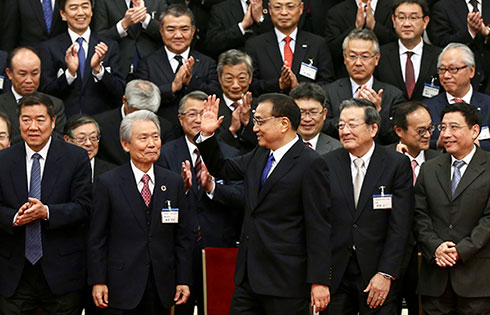
Trade and investment between China and the Association of Southeast Asian Nations are expected to more than double by 2020, Premier Li Keqiang said on Tuesday.
These goals are part of what the premier calls a "diamond decade" of relations the two must strive to achieve.
Trade is expected to reach $1 trillion in 2020, compared with $400 billion last year, Li said at the 10th China-ASEAN Expo, which opened on Tuesday in Nanning, capital of the Guangxi Zhuang autonomous region.
Two-way investment will amount to $150 billion from 2013 to 2020, Li said.
By the end of June, China's outbound direct investment in ASEAN nations totaled nearly $30 billion, and direct investment from ASEAN nations flowing into China exceeded $80 billion.
Calling China and ASEAN "natural cooperative partners", Li said the two share common goals.
"The major task of China and ASEAN is to develop economies and improve the people's livelihood," he said.
This year also marks the 10th year that the two sides have an established strategic partnership, and trade in 2012 was five times that of 2003.
"Since China and ASEAN were able to build a golden decade of cooperation in the past 10 years, they will be capable of building the next 10 years into a diamond decade," Li said.
At the opening ceremony of the expo, China and ASEAN signed three economic agreements covering ports, technology transfer and an entrepreneur association.
Cooperation with China is of great importance to ASEAN given the volatility in the emerging markets that erupted after the US Federal Reserve started to scale back its massive bond-buying program, said Huo Jianguo, president of the Chinese Academy of International Trade and Economic Cooperation.
Ty Channa, deputy director of the Cambodian Agricultural Research and Development Institute, said ASEAN is betting on strengthened ties to weather the global economic downturn.
"I am highly optimistic about the goal of achieving $1 trillion in bilateral trade, because our connection is stronger than ever after a 10-year strategic partnership. I think cooperation on the agricultural front will be essential to boost our economy," he said.
Panya Boonbandanrit, deputy secretary-general of the Thai Tapioca Trade Association, said China-ASEAN trade is "still set to enjoy steady growth, since bilateral trade practices have matured in the past decade".
Thailand and its neighboring countries are highly dependent on China's demand.
Huo said the free trade agreement, carried out in 2010, can serve as a foundation for the two to enhance their ties.
The free trade area is the world's largest in terms of the population it covers, and the largest among developing countries.
The FTA has greatly boosted economic ties. In 2012, China was the largest trade partner for ASEAN, and the region was the third-largest trade partner for China.
Premier Li called for renewing and expanding the agreement, further lowering taxes, reducing non-tax barriers, launching a new round of talks over services and creating more convenience for bilateral trade and investment.
China is keen to sign "long-term agreements on agricultural trade" with ASEAN, and the nation will "actively expand imports of commodities that enjoy competitiveness in the Chinese market" from the region, Li said.
According to Dato Norhalim Yunus, chief executive officer of Malaysian Technology Development Corp, a government-run venture capital firm, the "upgraded version" of the partnership suggested that China-ASEAN trade is more likely to go beyond brick-and-mortar businesses and move to high-end sectors, including high-tech.
China will accelerate infrastructure projects covering roads, rails, water transportation, airlines, telecoms and energy, and implement and promote key projects, including launching construction of the Trans-Asian Railway, Li said.
As economic exchanges are enhanced, connectivity becomes an increasingly important issue, and China has helped ASEAN members build infrastructure and set up funds.
"Better connectivity between us can only be achieved through an intensified infrastructure buildup, removing hurdles for technology transfers and enhancing people-to-people contact," said Huang Hao, sales director of Guangxi Sacred New Energy.