India fury over gang rapes sign of change


 |
|
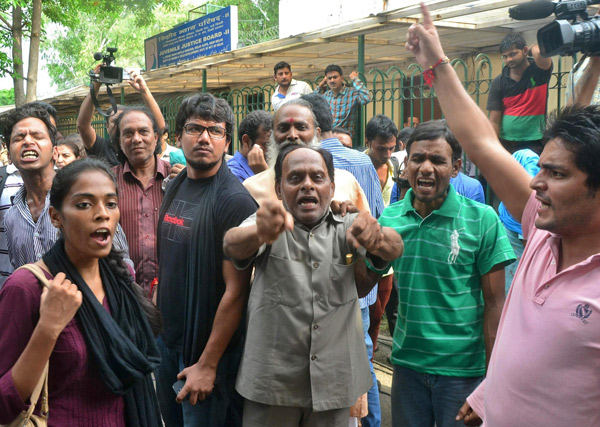
Demonstrators shout slogans outside a juvenile court in New Delhi August 31, 2013. An Indian teenager was sentenced to three years in juvenile detention on Saturday for the December gang rape of a trainee physiotherapist, the first verdict in a case that sparked debate over whether India was too soft on young offenders. The demonstrators were demanding capital punishment for the teenager. [Photo/Agencies] |
Yet another high-profile gang rape last month, against a photojournalist on assignment in Mumbai, renewed public fury and sent the media into 24-7 coverage marked by daily front page headlines and talk shows debating how to make India safe for women.
"There is very clearly a class dimension" that is compounding the sudden outrage, women's rights lawyer Flavia Agnes said.
All five of the accused in the Mumbai attack had little to no education, and three had previously been arrested for theft, Mumbai police said. They lived in the slums near the abandoned textile mill where the woman was raped.
In both the Mumbai and the Delhi cases, "middle-class people identified with these young girls, aspiring professionals, trying to make their mark in a competitive world," said Sudha Sundararaman, an activist with the All India Democratic Women's Association.
Experts say the rapid growth of India's cities and the yawning gulf between rich and poor are exacerbating the problem, with young men struggling to prove their traditional dominance in a changing world.
"These are young men in the cities, without prospects, without hope. They feel rage against those who are perceived to have it," sociologist Sudhir Kakar said.
Cultural stigmas, police apathy and judicial incompetence have long made it difficult for women to even report rapes.
But if modernization is changing the risks women face, it is also giving them the ability to speak up. In the first three months after the December bus rape, the number of rapes reported in the city more than doubled to 359, from the 143 reported in January-March of 2012.
Those numbers, in a city of almost 17 million people, are still seen by experts as far below the actual number of attacks, but the jarring increase in just one year appeared to signal a significant change.
"The biggest change is that women in the middle classes are reporting crimes to police," Kakar said. They are fed up with the landscape of sexual harassment and fear, with the constant barrage of lewd comments and even groping _ locally known as "eve-teasing" _ and with being told they should stay indoors at night.
"Thirty years ago, even uttering the word 'rape' was almost taboo. That is changing," said Ranjana Kumari, a women's activist with the Center for Social Research. "There are so many cases, each more gruesome than the other, and people have lost patience, especially when no justice is served."
The photojournalist attacked last month stunned the nation by telling local media that "rape is not the end of life" _ a groundbreaking statement given that many rape victims are still often dismissed as defiled. Many are shunned by their families, fired from jobs or driven from their home villages. As a result, most rape victims are still thought to remain silent.
"What's wrong with the system?" Supreme Court Justices R.M. Lodha and Madan B. Lokur said in a statement last week, while hearing a petition from the father of a 15-year-old girl gang-raped by three men in 2012, according to Indian media. The girl, who is a dalit, member of the outcast community once known as untouchables, has since been barred from her school in north India, and her mother was killed for refusing to withdraw a police complaint about the crime, according to Press Trust of India.
The court lambasted India's poor record of conviction in rape cases, saying "Why are 90 percent of rape cases ending in acquittals? The situation is going from bad to worse."