Japan suspends rocket launch at last minute


Japan suspended the launch of its next-generation solid-fuel rocket on Tuesday just seconds before liftoff after engineers discovered a technical glitch.
 |
|
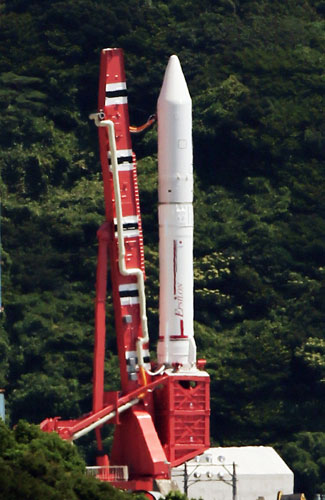
Japan's new solid fuel rocket Epsilon stands on a launching pad at the Uchinoura Space Center in Kagoshima on Tuesday. JiJi Press via AFP |
Japan Aerospace Exploration Agency had planned to launch the Epsilon rocket, the country's first rocket in 12 years, from the Uchinoura Space Center in Kagoshima, using just two laptop computers in a pared-down command center.
But the countdown was automatically halted just 19 seconds before blastoff "as an emergency measure due to some abnormal positioning" of the rocket, an agency spokeswoman said.
It was not clear if this was a physical problem or a data error, she added.
"We canceled today's launch and can't say anything about the timing of our next launch, as the cause of the trouble is still unknown," she said.
Ichita Yamamoto, the Cabinet minister in charge of space technology, urged the agency swiftly to relaunch the rocket, which Japan hopes will become competitive in the global space business.
"The cancellation was very regrettable," Yamamoto told a joint news conference with agency executives.
"But this rocket must be launched successfully," he said. "As the minister of space policies, I strongly hope the agency will pursue the cause and realize the launch."
The three-stage Epsilon - 24 meters long and weighing 91 metric tons - was scheduled to release the telescope "SPRINT-A" at an altitude of 1,000 kilometers.
SPRINT-A is the world's first space telescope for remote observation of planets including Venus, Mars and Jupiter from its orbit around Earth.
The Epsilon is about half the size of the nation's liquid-fueled H2-A rocket, and a successor to the solid fuel M-5 rocket that was retired in 2006.
The small-sized rocket is equipped with artificial intelligence "for the first time in the world" that allows autonomous checks by the rocket itself, the agency said.
"It also allows us to carry out launching procedures, including ignition, through only two laptop computers," another agency spokeswoman said.
At the control center, only eight workers were engaged in the launch operation, compared with some 150 people usually needed when the agency launches its mainstream H2-A rocket.
The agency has halved the production and launching cost to 3.8 billion yen ($37 million) from that of the previous M-5.
"Catching troubles before the launch means the entire system is still under control," said Tetsuya Hanyu, a researcher at Mitsubishi Research Institute.
"But it may take some time to relaunch it if the trouble is found to be serious enough to require the replacement of major parts, for instance."